
Würth Elektronik’s Tarvos-e and Olis-e Radio Modules Offer Flexible Proprietary Wireless Options
Würth Elektronik’s Tarvos-e and Olis-e radio modules use compact hardware and proprietary protocols to deliver long-range, low-power wireless alternatives to Bluetooth.
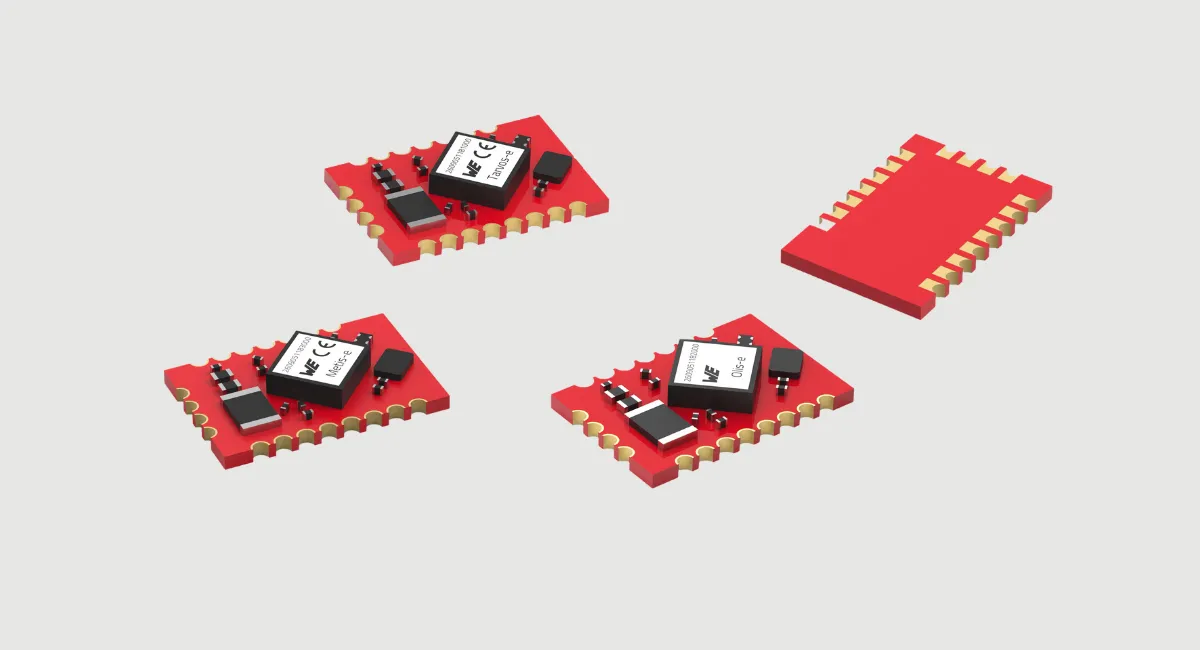
Würth Elektronik has introduced two new modules designed for this space. The Tarvos-e and Olis-e are based on the Texas Instruments CC1310 system-on-chip and measure only 12 × 8 × 2 mm. Despite their small footprint, they provide a flexible platform for proprietary wireless implementations that go beyond the constraints of off-the-shelf protocols.
Tarvos-e: Protocol Flexibility
The Tarvos-e module runs Würth Elektronik’s WE-ProWare protocol, which is already compatible with earlier Tarvos-III and Thebe-II devices. It gives designers the choice to prioritise either data rate, up to 400 kbps, or communication range, which can reach 2.7 km in favourable conditions.
With an RF output power of 14 dBm and a simple UART interface, Tarvos-e suits designs where engineers need reliable connectivity but want more control than Bluetooth typically allows.
Olis-e: Build Your Own Firmware
The Olis-e module takes flexibility further by giving engineers direct access to the TI SIMPLELINK CC13x0 software development kit. Developers can program the SoC to run their own firmware, define custom protocols, and even embed system logic directly onto the module.
This approach lets engineers build highly tailored wireless solutions without the need for a separate microcontroller, which reduces overall board complexity and power consumption.
Why Proprietary Protocols Still Matter
Standard wireless technologies dominate consumer products, but they are not always optimal in industrial or metering applications. Operating at 868 MHz instead of 2.4 GHz, the Tarvos-e and Olis-e modules achieve stronger indoor performance and more reliable transmission through walls and other obstructions.
For use cases where both the transmitter and receiver are controlled by the same designer, proprietary protocols can deliver better efficiency and longer battery life than general-purpose standards. The modules’ low-power modes are also notable, with standby current as low as 1.6 µA and shutdown down to 200 nA.
Options and Evaluation Tools
Both modules are available for the 868 MHz European band, with a 915 MHz variant offered on request for use in regions such as the United States. Developers also get access to evaluation boards with USB connectivity, full documentation, and supporting software, making prototyping straightforward.
By building on a shared hardware platform with the earlier Metis-e module, Würth Elektronik has ensured consistency across its proprietary radio family, giving engineers options without forcing them to change design foundations.
A Practical Alternative
The Tarvos-e and Olis-e show how proprietary wireless approaches remain valuable alongside mainstream standards. With their compact form factor, efficient power modes, and flexible protocol support, the modules open new options for engineers designing battery-powered devices, metering systems, and industrial equipment.
Learn more and read the original article on www.we-online.com
Related news
More from Würth Elektronik
Keep up with the components and technology shaping electronics.
Join the club for member features, engineering discussion and easier access to the latest Component Club content.