
EPC Unveils 5 kW GaN AC DC System for AI and Data Center Racks
EPC demonstrates a 5 kW GaN AC DC reference design improving efficiency and power density for AI servers and data center racks.
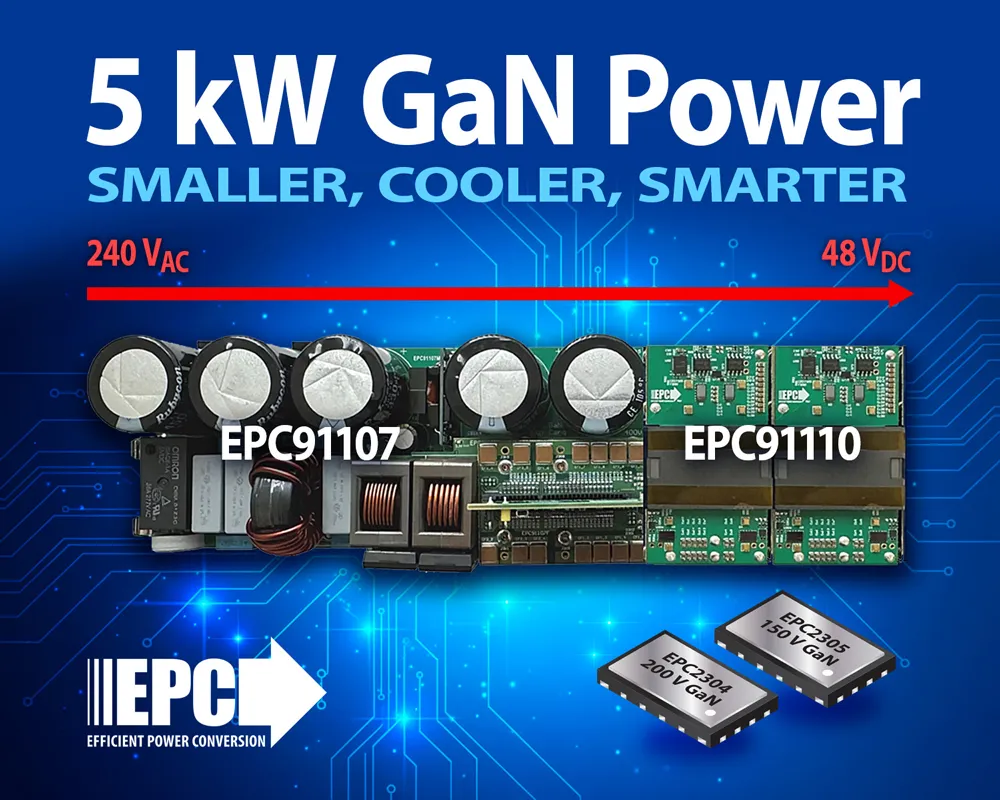
That shift has drawn attention to gallium nitride technology. Its low switching losses allow smaller magnetics and more compact power stages. Efficient Power Conversion Corporation has released a 5 kW AC to 48 V DC reference design that shows how these advantages translate into real data center hardware.
A Complete 5 kW GaN System for Rack Power
The system includes two coordinated designs. The EPC91107KIT front end acts as the AC to intermediate bus converter, while the EPC91110KIT forms the isolation and step down stage to 48 V. Together they match the output requirements of AI server racks and Open Rack V3 power specifications.
By using GaN in both sections, EPC has focused on reducing thermal overhead and magnetic volume. The result is a compact and modular architecture that can be placed into existing rack formats without resizing power bays.
System Efficiency and Topology Breakdown
The front end uses a flying capacitor four level totem pole PFC stage with EPC2304 GaN FETs. The high switching frequency cuts the inductor size by nine times compared to conventional two level silicon designs. Efficiency can reach 98.5 percent at 5 kW under nominal input conditions.
The isolation stage steps from 400 V to a regulated 48 to 50 V output. It uses four LLC modules operating in an input series output parallel configuration so thermal load is shared. Each module uses an EPC2305 device and contributes to a combined peak efficiency of around 98.2 percent.
Scalability and Integration Considerations
The design supports modular expansion, allowing system architects to scale from 5 kW to 33 kW, 48 kW and beyond by adding more converter boards. This makes it suitable for a range of rack power layouts and enables gradual capacity increases as server density rises.
Engineers evaluating GaN can use the reference design as a layout and thermal guideline. The high operating frequency reduces passive component volume, which directly increases volumetric power density.
Why GaN Matters in Modern Server Power
Data centers want to supply more power through the same infrastructure to support growing AI workloads. Smaller magnetics and higher efficiency reduce cooling requirements and free up space. This reference design demonstrates how GaN can improve the practical limits of power shelves without redesigning entire racks.
Learn more and read the original announcement on www.epc-co.com
Related news
More from Efficient Power Conversion
Keep up with the components and technology shaping electronics.
Join the club for member features, engineering discussion and easier access to the latest Component Club content.