ST Expands STM32 AI Model Zoo With 140+ Edge AI Models for Physical AI Development
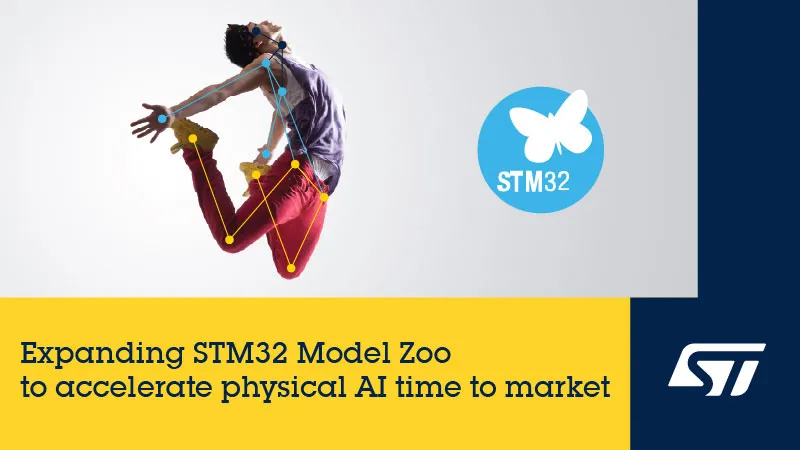 STMicroelectronics has expanded its STM32 AI Model Zoo, adding new models, broader framework support and updated workflow tools aimed at making embedded AI far easier to develop. The update effectively doubles the size of the existing library and reinforces ST’s push toward what it calls Physical AI, where intelligence runs locally on small, low-power devices rather than on cloud servers.
A Growing Need for Lightweight AI at the Edge
Most embedded systems still rely on microcontrollers with tight constraints on memory, compute and energy. That creates a challenge for engineers who want to add vision, audio or sensor-driven intelligence without redesigning entire platforms. The Model Zoo extension targets exactly this gap. ST has introduced more than 140 ready-made models spanning object detection, gesture recognition, audio classification and environmental sensing, all shaped for microcontroller-class hardware.
The motivation is simple. Moving small AI models onto MCUs avoids network latency, reduces power consumption and improves privacy. It also allows manufacturers to integrate intelligence into products that would never justify a dedicated AI processor. Examples include wearables, home appliances, industrial sensors and access-control systems.
A Workflow That Goes Beyond Prebuilt Models
Rather than acting as a static catalogue, the new Model Zoo adds features that support the full journey from training to deployment. The tooling includes scripts that help convert and optimise models, along with utilities that generate the application-level glue code needed to integrate AI tasks into broader STM32 firmware. This is intended to shorten the path between experimentation and field-ready prototypes, which has traditionally been a slow part of edge AI development.
One of the more visible changes is native support for PyTorch models. Until now, STM32 AI workflows were largely centred around TensorFlow Lite and Keras, so PyTorch compatibility opens the door to a much larger community of developers. The update also improves support for LiteRT and ONNX formats, which makes it easier to migrate existing PC-based models onto constrained devices.
Quantisation and Compression for Real Hardware
To make AI feasible on small microcontrollers, ST has put significant emphasis on model compression. The newest version includes sub-byte quantisation options and improved memory-reduction strategies that preserve accuracy while lowering compute cost. These techniques matter because even a modest drop in model size can determine whether a feature is practical on a 32-bit MCU.
For manufacturers building battery-powered or thermally constrained products, these optimisations can be a decisive factor in bringing AI features to market.
A Broader Push Toward Physical AI
The Model Zoo sits within ST’s wider Edge AI Suite, a toolbox of libraries, model converters and profiling tools designed to help developers ship embedded AI at scale. ST claims that these tools support more than 160,000 projects each year, reflecting how aggressively the industry is moving toward lightweight intelligence at the edge.
With the introduction of AI-accelerated MCUs such as the STM32N6 series, ST is positioning itself as a key supplier for next-generation embedded AI hardware. The expanded Model Zoo strengthens that position by lowering the barrier to entry and providing engineers with a starting point that reduces both risk and development time.
Learn more and read the original announcement at www.st.com
You may also like