
EPC’s GaN Integration Brings New Agility to Robotic Motion
EPC’s EPC91120 reference design combines GaN power, sensing, and control in a 32 mm module, improving efficiency and responsiveness in robot joints and UAVs.
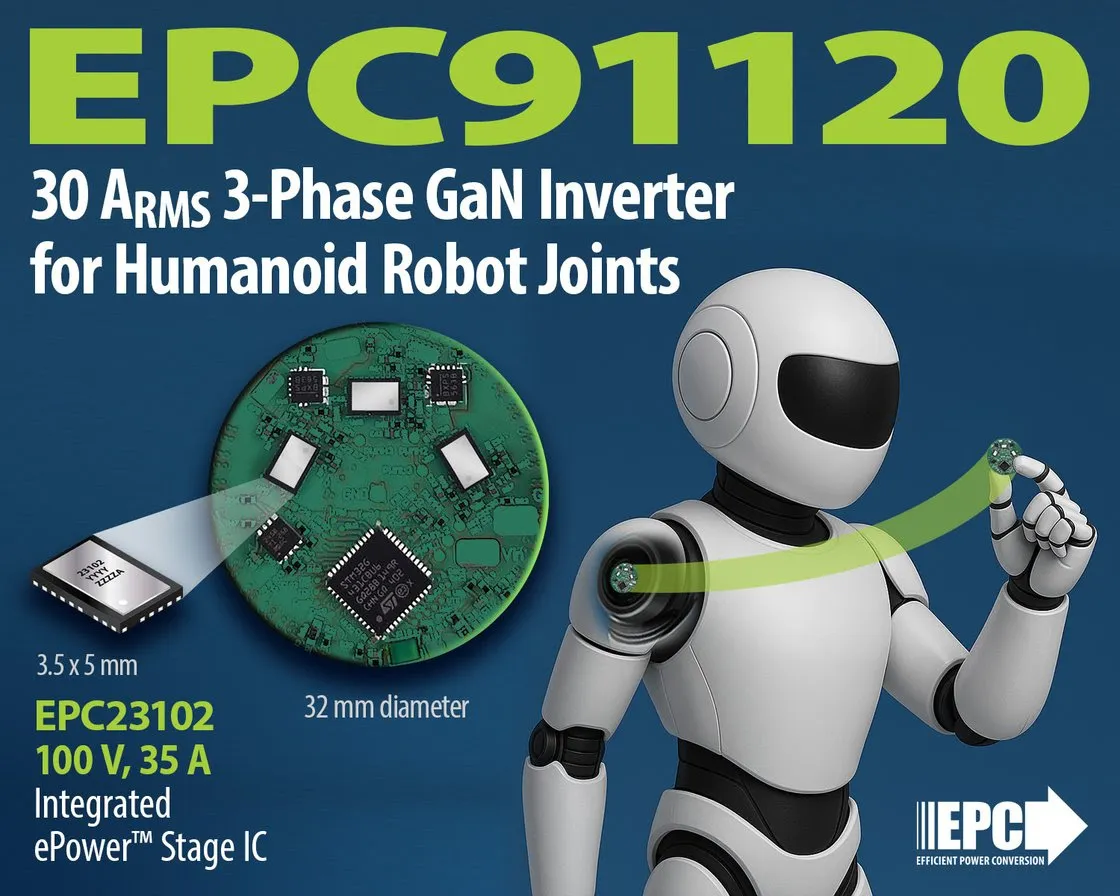
Integration Inside the Joint
Rather than mounting the inverter and sensors in a separate enclosure, EPC’s engineers fitted everything directly inside the motor assembly. The 32 mm circular board carries three half-bridge GaN ICs, voltage and current sensors, a small controller, and communication support for RS485 and magnetic encoders. Keeping the electronics this close to the motor improves signal timing and avoids the wiring losses that usually appear in external driver designs.
The system operates from 15 V to 55 V and delivers peaks around 21 A. It switches at 100 kHz with a short 50-nanosecond dead time, which allows precise torque control and smooth motion. This level of responsiveness is essential for humanoid robots that need to move more like people than machines.
Managing Heat Without Compromise
Thermal performance is often the limiting factor in compact actuators. During testing, the board handled roughly 7 ARMS per phase in free air. When installed inside a joint housing that doubles as a heatsink, it reached 15 ARMS while maintaining more than 80 percent total efficiency from input to mechanical output. These results show how high-frequency GaN switching can support both power and efficiency without increasing size.
Why GaN Changes Motion Design
Gallium nitride switches faster than silicon, which means designers can use smaller passive components and achieve tighter control loops with less energy loss. In real terms, that gives robot limbs and drone rotors a more immediate response. Systems that once needed bulky external drivers can now be built smaller and lighter, improving agility and extending runtime.
By combining the inverter, sensing, and control electronics in a module small enough to sit inside the motor itself, EPC demonstrates how GaN technology can move robotic motion closer to the smooth, efficient behaviour of biological systems.
Learn more and read the original article on www.epc-co.com
Related news
More from Efficient Power Conversion
Keep up with the components and technology shaping electronics.
Join the club for member features, engineering discussion and easier access to the latest Component Club content.