Melexis Launches Automotive-Grade SMD Infrared Sensor for EV Powertrain Thermal Monitoring
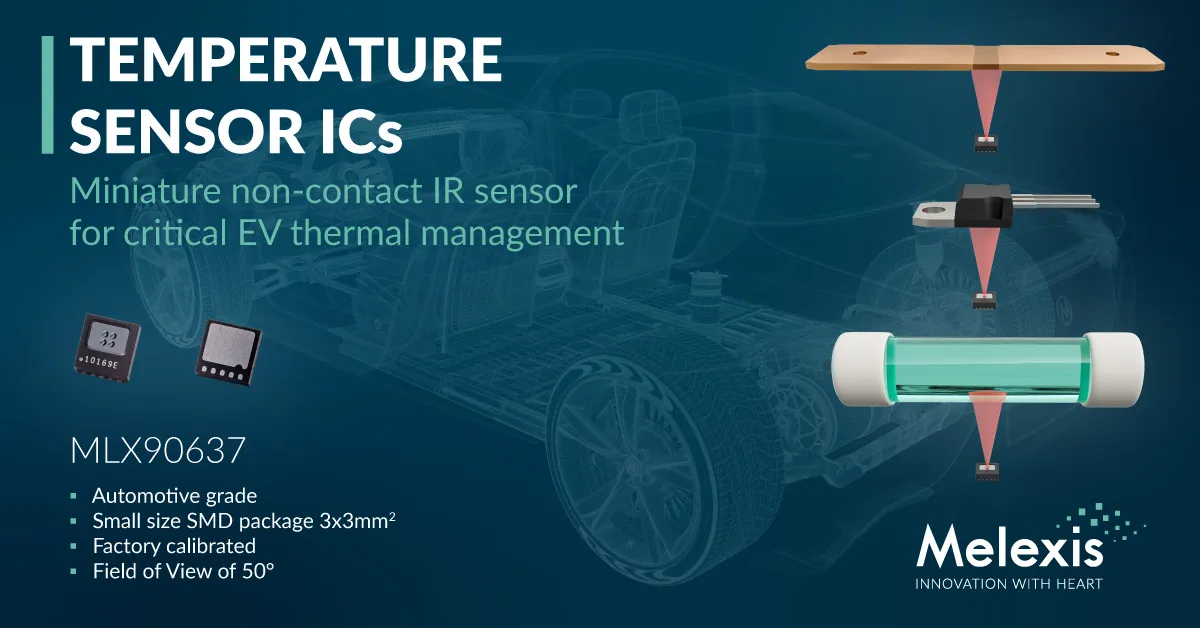
Melexis introduces the MLX90637, the first automotive-qualified SMD infrared temperature sensor for EV powertrain systems, offering fast non-contact thermal monitoring.
Why Surface-Mount FIR Sensing Matters in EVs
Controlling temperature in electric vehicles is not a convenience feature. It is tied directly to safety, service life and overall performance. Power inverters, motors and HVAC components all generate heat in different ways, and the faster a system can understand those temperature changes, the more aggressively it can manage its operation. Engineers usually rely on NTC thermistors for this work, but they come with wiring, EMC issues and installation steps that do not always blend well with high-volume automotive production.
This is where the MLX90637 stands out. Because it is manufactured as an SMD component, it drops straight into automated PCB assembly lines. It removes the manual placement steps that most NTC solutions still require, reducing cost and improving consistency across builds. It also helps with galvanic isolation, which is important in EVs where designers try to keep low-voltage electronics as far away from the high-voltage domain as possible.
Designed to Handle Harsh Automotive Conditions
Automotive temperature sensors often live in unpleasant locations. They experience vibration, sudden thermal swings and electromagnetic noise created by power electronics. The MLX90637 is built for these challenges with an operating range from minus 40 degrees Celsius to 125 degrees Celsius. Because it uses far-infrared sensing, it does not need physical contact with the surface it measures. That brings some clear advantages for busbars, where exposed electrical paths can be difficult to instrument safely.
In terms of performance, the device offers a 50 degree field of view and a typical resolution of 0.02 degrees Celsius. This combination means engineers can track small changes in temperature quickly, which is valuable for inverter protection and thermal derating strategies. The sensor also responds rapidly, and this speed helps powertrain control systems adjust behaviour before temperatures reach critical limits.
Assembly and Integration Benefits
Beyond measurement accuracy, integration is one of the major talking points. The MLX90637 runs from a 3.3 volt supply and communicates over I2C, which keeps it compatible with most automotive microcontrollers. Melexis provides full factory calibration, including post-calibration steps, so developers do not need to add complex correction routines or extra testing overhead. The 3 by 3 millimetre package helps when space is tight or when designers want multiple sensors across a power module to catch localised hotspots.
Choosing an SMD FIR sensor over an NTC also has cost implications. Even though FIR sensors are more advanced devices, removing hand-built harnesses, crimping, inspection and through-hole assembly steps brings down total system cost. Compared with TO-CAN packages, the SMD version reduces overall component height and weight while maintaining the accuracy required for automotive environments.
Positioning the MLX90637 in the EV Landscape
As EV architectures continue to evolve, thermal management is becoming a more important part of system design. Non-contact sensing offers a clearer picture of what is happening across high-power modules, and the ability to place sensors on standard PCBs without additional wiring gives engineers more freedom to monitor where it matters most. Melexis has a long history of producing FIR sensors, and the MLX90637 continues that trend with a focus on automotive reliability and manufacturability.
By combining temperature accuracy, safety benefits and ease of assembly, the MLX90637 positions itself as a practical option for EV manufacturers looking to improve protection strategies without adding complexity to their production lines.
Learn more and read the original article on www.melexis.com
Related news
More from Melexis
Keep up with the components and technology shaping electronics.
Join the club for member features, engineering discussion and easier access to the latest Component Club content.