
Microchip Cuts Power Monitoring Load for Portable Designs
Microchip’s PAC1711 and PAC1811 monitors cut measurement power while improving event driven visibility for battery based designs.
Why Accurate Monitoring Matters
Power constrained designs such as handheld tools, compact industrial devices, edge AI nodes and embedded sensors depend on fine grained control of their energy budget. Engineers frequently need to observe changes in load behaviour, wake only when necessary and avoid wasting power on continuous measurement. Traditional monitor ICs often burn more power than designers would like, particularly when sampling at higher rates. Microchip’s approach is to treat the monitor as an independent peripheral that keeps watch while the host processor remains in a dormant state until a meaningful event occurs.
Key Technical Capabilities
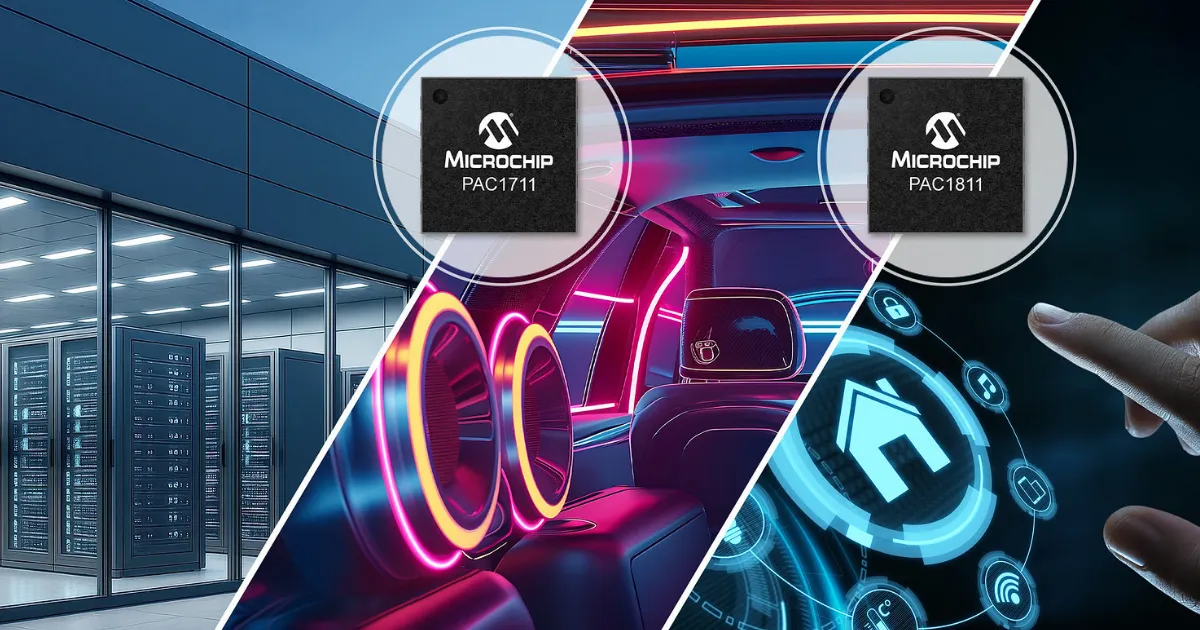
The PAC1711 and PAC1811 target systems that need low power measurement without compromising resolution. The PAC1711 uses a 12 bit converter while the PAC1811 increases that resolution to 16 bits, which helps in designs where fine control loops depend on understanding subtle current shifts. Both devices support bus voltages from 0 to 42 volts and communicate over I2C, which keeps integration simple for both embedded Linux and MCU based systems. Microchip has also introduced a step alert function that maintains a running average of voltage and current measurements. When user defined thresholds are breached, the monitor signals the MCU, allowing it to respond without polling. This event driven workflow can extend battery life in systems where wakeups are expensive.
A slow sample mode is available for designs that need occasional snapshots rather than continuous tracking. Sampling every eight seconds may sound infrequent, but it suits devices that mostly sleep or operate in steady state conditions. An accumulator register supports energy trending, battery ageing analysis or short term profiling for predictive maintenance in industrial compact equipment. These features move the device beyond simple measurement and support more nuanced system behaviour without increasing code complexity on the host processor.
Design Considerations and Use Cases
Both monitors arrive in compact VDFN packages, offered in pinouts that match common SOT23 layouts. This allows engineers to swap devices during late stage prototyping or qualify Microchip as a second source without changing the PCB. That compatibility often matters when long product lifetimes or constrained supply chains are involved. The devices also avoid unnecessary processing overhead by keeping measurement tasks off the MCU. In practice this could reduce power spikes during display activation, peripheral enable sequences or system wakeups.
Applications range from handheld equipment that needs predictable standby life, to networked sensors that run periodic operations, to AI and ML devices that rely on efficient real time power profiling. Because the monitors support up to 42 volt rails they also fit into light mobility and industrial control systems, where supply variation and load transients can make monitoring more demanding.
Implications for Future Designs
Low power supervisory components like these are becoming more relevant as designers push for longer runtimes and better visibility on real load behaviour. Event driven power monitoring is a practical shift away from traditional polling methods that have dominated embedded workflows for years. For engineers, the takeaway is simple. Smarter monitoring can directly translate into longer battery life, more predictable system behaviour and better long term maintenance data. Microchip’s latest parts fit neatly into that direction and give designers a drop in option that reduces measurement overhead without adding architectural complexity.
Learn more and read the original announcement at www.microchip.com
Related news
More from Microchip
Keep up with the components and technology shaping electronics.
Join the club for member features, engineering discussion and easier access to the latest Component Club content.