Toshiba and MIKROE Simplify Automotive DC Motor Prototyping
Toshiba’s SmartMCD TB9M001FTG board streamlines development of dual brushed DC motor control systems.
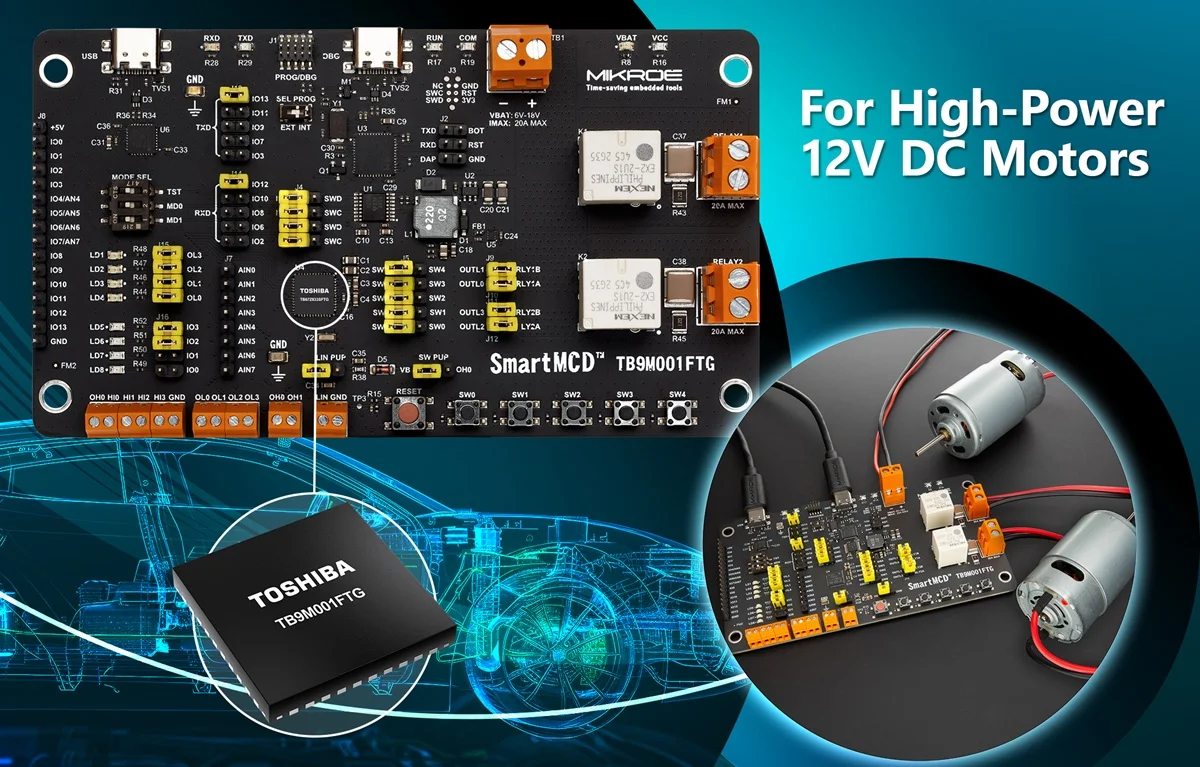
The appeal of the board is not just that it drives two brushed DC motors. It allows engineers to evaluate the TB9M001FTG smart motor control driver in conditions that resemble real automotive environments. Instead of building a stack of support circuitry before any software experimentation can begin, the board arrives with the core control, protection, and communication features already wired in.
Reducing Integration Effort in Body Control Systems
During early design work, a surprising amount of time goes into making relays, drivers, microcontrollers, and bus interfaces speak the same language. The TB9M001FTG shortens that cycle by giving engineers forward and reverse control of two brushed DC motors through relay-based H-bridge configurations that mirror how many production body modules are still built. It also meets AEC-Q100 Grade 1 and aligns with ASIL-A expectations, which helps ensure that early tests reflect the behaviour of qualified silicon rather than a functional approximation.
These factors matter because body control electronics must cope with voltage dips, stalled motors, harsh temperature swings, and electrical noise long before they become polished production units. Starting evaluation on a device that already accounts for these realities can remove a round of redesign later.
Integrated Control and Safety Architecture
The SmartMCD device includes an Arm Cortex-M0 microcontroller with 192 kB of Flash, 16 kB of RAM, and additional data Flash, all wrapped in ECC protection. That means real control code, signal handling, and diagnostics can run on the same device that manages the motors, rather than offloading everything to an external MCU.
Fault handling is built into the silicon rather than left to the rest of the system. The device watches for overcurrent on both the low-side and high-side stages, tracks supply conditions for over and undervoltage events, and will shut itself down if junction temperature runs away. This matters because these are the failure modes that typically surface in early body-module testing, such as when a wiper stalls or a window mechanism hits a fixed stop.
Power, Communication, and I/O in a Single Platform
Power stages often make early prototypes untidy. Extra regulators, transient suppression, and support rails are usually added just to keep a motor driver stable on an automotive battery line. The TB9M001FTG integrates the required power management internally, generating its own operating voltages from the 12 V supply. In practice, this lets engineers explore control behaviour and fault response earlier without first building a separate power subsystem.
Connectivity is handled with a built-in LIN transceiver, which is still the backbone of many body electronics networks. Multiple GPIOs are broken out and can be reconfigured with jumpers, making it easy to attach switches, sensors, or loads without committing to a full wire harness. The 130 mm by 73 mm layout remains compact enough for bench setups where motors, relays, and cabling can quickly take over the workspace.
Why Integrated Motor Drivers Are Showing Up in Prototypes Earlier
The collaboration between Toshiba Electronic Devices & Storage Corporation and MIKROE fits a broader trend toward development hardware that better reflects real automotive subsystems. When the MCU, diagnostics, motor drive, power management, and vehicle network interface all sit inside one architecture, engineers can validate behaviour far earlier in the cycle. Control algorithms, communication timing, safety routines, and load handling can be exercised long before the design migrates into a full PCB.
For teams under pressure to shorten development cycles, this kind of platform reduces friction. It lets engineers focus on how the system behaves rather than on assembling the infrastructure required just to begin testing.
Learn more and read the original announcement at www.toshiba.semicon-storage.com
Related news
More from Toshiba
Keep up with the components and technology shaping electronics.
Join the club for member features, engineering discussion and easier access to the latest Component Club content.