
EPC’s First Gen 7 eGaN FET Pushes Power Density in 40 V Designs
EPC’s new 40 V Gen 7 eGaN transistor offers low RDS(on) and reduced switching loss for compact, high efficiency power stages.
Device Behaviour at High Current and Fast Switching
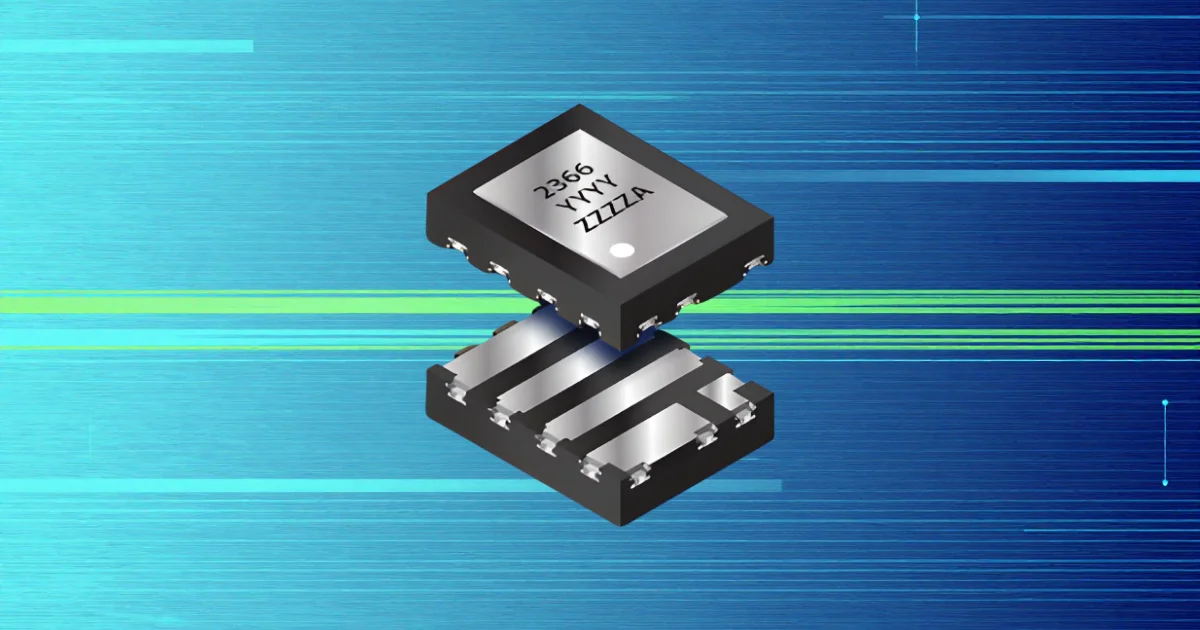
The EPC2366 is a 40 V enhancement mode GaN FET with a typical RDS(on) of 0.8 milliohms. What stands out is how the device balances this conduction performance with a low charge profile. The RDS(on) multiplied by QG figure comes in under 12 milliohm nanocoulombs, which helps reduce switching losses in converters that operate deep into the hundreds of kilohertz. In practice, this kind of behaviour gives engineers more freedom when shaping efficiency curves because the device handles both low duty cycle conditions and hard transients without forcing tradeoffs that silicon usually imposes. The FET supports continuous drain currents up to 88 amps and pulsed currents up to 360 amps, which aligns with the demands of high current synchronous rectification and multiphase DC to DC systems where current spikes appear during load transitions.
Packaging and Thermal Considerations
A detail that becomes important when working on dense power stages is how heat moves through the package and into copper. The EPC2366 comes in a 3.3 by 2.6 millimetre PQFN with a junction to case thermal resistance of 0.6 degrees Celsius per watt. That low resistance helps keep the temperature gradient manageable when switching at elevated frequencies, especially when designers rely on compact copper pours or shared thermal paths in stacked architectures. The small footprint also supports layouts that aim to reduce parasitic inductances, which can improve switching behaviour and expand the usable frequency range. These characteristics matter most in boards used for server power modules, advanced motor control stages, and high density synchronous rectifiers where size and thermal margins are often closely linked.
Designing With the Device and Evaluation Support
For engineers moving from silicon to gallium nitride, access to reference hardware can shorten the path from evaluation to deployment. EPC offers the EPC90167 evaluation board, a half bridge platform featuring two EPC2366 devices in a layout designed to keep parasitics low. It accepts standard PWM drive signals and allows designers to examine real switching waveforms, thermal performance, and behaviour under load changes before committing to a production layout. This is useful when validating converters for AI server power supplies or motor drives where switching characteristics and thermal recovery under dynamic loads need to be confirmed early. Volume availability through distribution channels removes a common barrier that appears when evaluating newer device families, making it easier for teams to scale prototypes into production.
Planning for Wider Adoption of Seventh Generation GaN
The EPC2366 marks the first member of the seventh generation platform from EPC to reach mass production. Additional 25 V and 15 V variants are already being sampled, which means the platform will likely extend into lower voltage stages as the year progresses. For engineers working on high efficiency converters, the key point is that this generation combines low RDS(on) behaviour with reduced charge to offer an alternative to silicon in designs where thermal and switching margins are tight.
Learn more and read the original announcement at www.epc-co.com
Related news
More from Efficient Power Conversion
Keep up with the components and technology shaping electronics.
Join the club for member features, engineering discussion and easier access to the latest Component Club content.