
Nisshinbo NT1199HEAE4S LNA Strengthens Multi-Band GNSS Reception
The Nisshinbo NT1199HEAE4S wideband LNA delivers high linearity, low noise, and stable gain across all major GNSS bands, helping navigation systems maintain accuracy in interference-heavy automotive, industrial, and consumer environments.
Wide GNSS Coverage Designed for Interference-Heavy Layouts
The NT1199HEAE4S spans 1164 to 1610 MHz, and that range matters because modern GNSS receivers spread across L1, L2, L5, and regional equivalents without leaving space for dedicated filtering between each path. The 0.65 dB typical noise figure keeps the amplifier quiet, yet the gain remains flat across all navigation bands. Nothing draws attention more than a board that works in one region of the spectrum and falls apart in another. Instead of chasing perfect alignment, the device holds its performance steady even when the RF background shifts. This consistency becomes noticeable during field tests where LTE downlink energy presses close to the antenna and the receiver has to hold lock without the luxury of controlled lab isolation.
Linearity That Holds When Nearby Radios Misbehave
The defining behavior of the NT1199HEAE4S is its tolerance to strong input signals. Input P1dB values reach around +1.5 dBm at L1 and about 0 dBm in the L2, L5, and L6 bands. In practice this means the amplifier resists compression when the system is exposed to aggressive emitters from Wi-Fi, BLE, or a shared satellite communication front end. Engineers often discover these interactions only after positional jumps show up in logs rather than immediate hard failures. An LNA that stays linear under that pressure reduces the need for reactive filtering, and the downstream baseband ends up receiving a cleaner, more predictable signal.
Practical Characteristics Shaped for Compact GNSS Modules
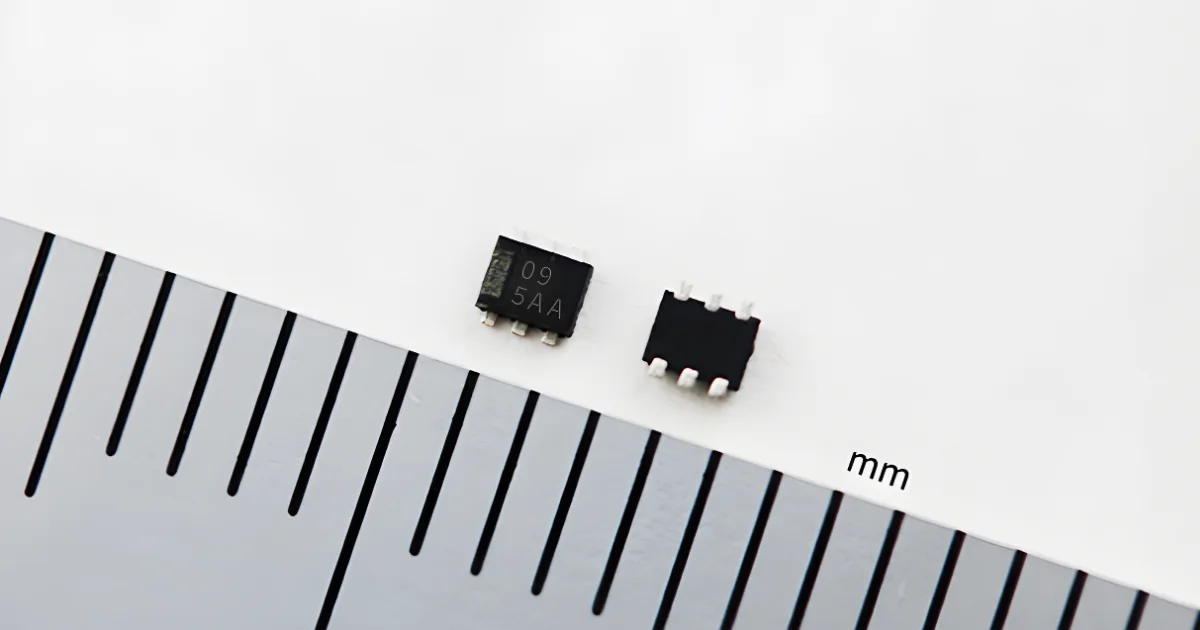
The device sits in a SON-6-HE package measuring 1.6 by 1.6 mm with a height near 0.55 mm. The small footprint helps in antenna-adjacent placement where trace length becomes as important as absolute performance. Its 12 mA operating current at 3.3 V looks modest, but what matters more is how it avoids thermal drift over long duty cycles. You notice this during late-stage debugging when the board has been powered for hours. The NT1199HEAE4S keeps behaving in a way that avoids the slow detuning that often appears in miniature active antennas or combination GNSS modules.
Positioned for GNSS Systems Exposed to Unpredictable RF Environments
GNSS integration used to be limited to navigation hardware. Now it appears in industrial trackers, automotive systems, consumer devices, and small communication modules that constantly share spectrum with other radios. That broader deployment brings rougher RF neighborhoods, not cleaner ones. A wideband, low noise, high linearity part like the NT1199HEAE4S suits that shift. The ongoing development of an AEC-Q100 automotive grade variant reinforces how these devices will likely face environments where interference is not controlled, only managed.
Learn more and read the original announcement at www.nisshinbo-microdevices.co.jp
Related news
More from Nisshinbo Micro Devices
Keep up with the components and technology shaping electronics.
Join the club for member features, engineering discussion and easier access to the latest Component Club content.