
Toshiba ST2000JXH35A 6500V IEGT Reshapes HVDC Stack Design
Toshiba’s ST2000JXH35A 6500V 2000A press pack IEGT targets HVDC transmission, STATCOM systems and industrial drives with improved turn-off margin and short-circuit withstand capability.
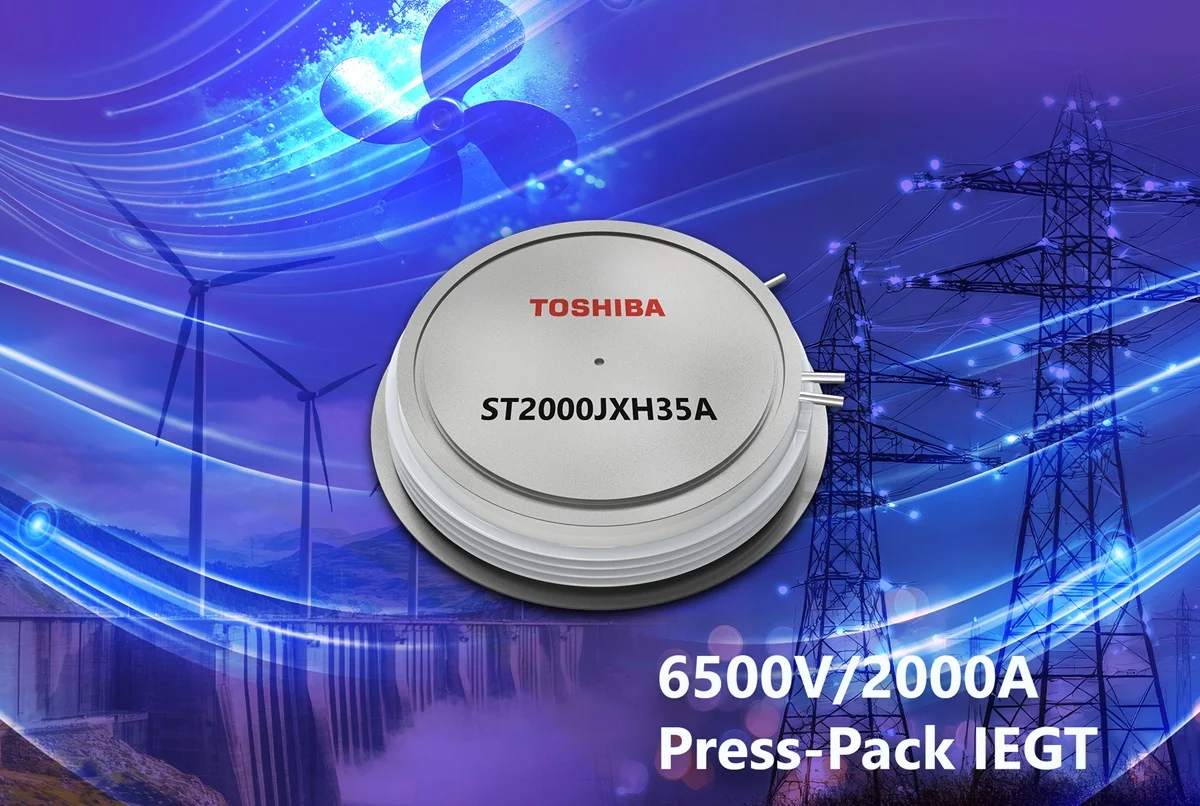
Using a 6.5kV class device reduces the number of series-connected switches required to withstand the DC link. That sounds like arithmetic, but it shifts several secondary pressures. Voltage sharing networks shrink. Gate drive timing margins loosen slightly because fewer devices must transition in perfect alignment. Thermal modeling becomes less crowded simply because there are fewer junctions stacked inside the same arm.
Turn-off stress is where devices of this size quietly earn their place. Toshiba has pushed the turn-off test voltage from 3600V in its earlier generation to 4500V here. That extra margin shows up when stray inductance and stored charge combine during high-current commutation, especially in large inductive systems where nothing turns off cleanly. The device has also undergone short-circuit testing at 4500V. In converter stations and STATCOM installations, that condition is not hypothetical. Protection circuits react, but not instantly. The silicon has to tolerate the delay.
Trench-Type IEGT Structure Under Load
Inside the ST2000JXH35A are newly developed trench-type IEGT chips with an optimized cell structure. At 2000A, current distribution across the die matters as much as the headline rating. Uneven conduction paths create localized heating that shortens lifetime long before the average junction temperature suggests trouble. A trench architecture helps manage electric field distribution and improves how the device handles turn-off under heavy load, where current tails and voltage overshoot tend to overlap.
Short-circuit withstand capability is tied closely to that internal geometry. When a fault occurs at elevated voltage, the device is exposed to simultaneous high current and high electric field stress. Surviving that event without degradation depends on how effectively the structure spreads both thermal and electrical load. The improvement to 4500V testing reflects that refinement rather than a cosmetic rating increase.
Press Pack Construction And Cooling Symmetry
The press pack format is not incidental. Double-sided cooling allows heat to exit both faces of the device, producing a more uniform temperature profile across the silicon. In large converter stacks where devices are clamped mechanically and expected to operate for decades, that symmetry influences reliability directly. Thermal gradients become lifetime multipliers.
Hermetic sealing addresses another long-term concern. Offshore HVDC platforms and remote transmission infrastructure do not offer easy maintenance cycles. Contamination, moisture ingress, and mechanical stress accumulate over time. A sealed press pack structure provides environmental stability that aligns with those deployment conditions.
Where This Device Lands In Grid Infrastructure
As renewable integration pushes more power through long-distance DC links, converter stations face increasing pressure to deliver higher voltage without expanding footprint or structural complexity. A 6500V device that can tolerate 4500V turn-off and short-circuit stress allows designers to reconsider how many elements truly need to be stacked in series. Industrial motor drives and reactive power compensation systems face similar constraints when scaling voltage upward.
The ST2000JXH35A does not redefine converter architecture overnight. It reduces one layer of stacking. Sometimes that is enough to simplify the rest.
Learn more and read the original announcement at www.toshiba.semicon-storage.com
Related news
More from Toshiba
Keep up with the components and technology shaping electronics.
Join the club for member features, engineering discussion and easier access to the latest Component Club content.