
Qualcomm Snapdragon Wear Elite Brings On-Device AI Compute to Power-Constrained Wearables
The Qualcomm Snapdragon Wear Elite platform introduces an NPU for on-device AI, multi-mode connectivity, and power-efficient compute islands to support next-generation wearables that run complex models while maintaining multi-day battery life.
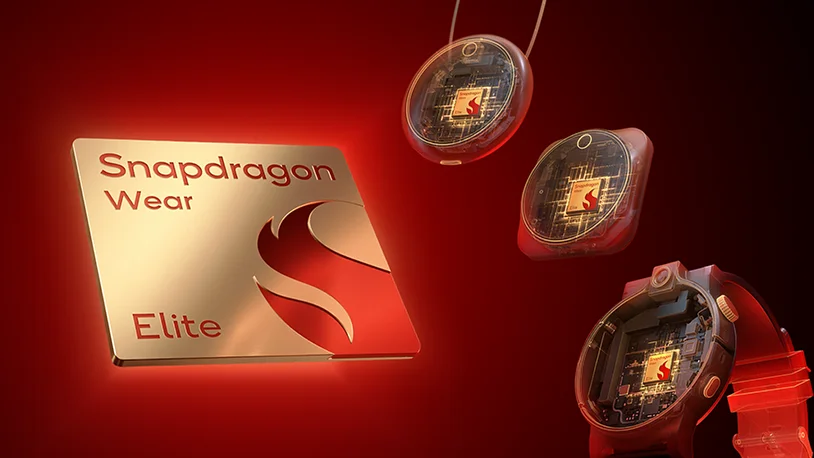
On-Device AI Compute Built Around a High-Efficiency NPU
Snapdragon Wear Elite integrates an on-device NPU capable of running models that reach into billion-parameter territory, yet it has to operate in a space where thermal margins are thin and battery size is fixed long before the PCB is drawn. In practice this gives engineers more room to build context-aware behaviors without leaning heavily on cloud inference. The NPU ties into sensor fusion hardware so motion, location, and environmental signals can be processed without waking higher power islands. This matters when designing devices that collect short pulses of information throughout the day rather than a continuous stream. Those small interactions add up, and the power cost of waking the main compute block often dominates everything else.
Balancing CPU, GPU, and NPU Workloads in a Constrained Thermal Envelope
The platform pushes CPU performance roughly fivefold and GPU throughput around sevenfold compared to the previous generation, but the useful part is how it coordinates these blocks so the thermal profile stays within what a watch shell, pendant, or pin can absorb. Wearables rarely dissipate heat through active airflow, so every workload with a high duty cycle has to be shaped carefully. The platform tries to keep bursts short and offload repetitive tasks to lower power blocks where possible. Engineers building gesture recognition, voice wake, or background monitoring pipelines can use these islands to reduce the time the main cores stay active, which is often what determines whether the device can reach multi-day battery life.
Connectivity Architecture That Reduces Radio Overhead
Wearables rely on several radios even when most applications focus on only one at a time. The platform integrates 5G RedCap, micro-power Wi-Fi, Bluetooth 6.0, UWB, GNSS, and NB-NTN. The challenge is not providing every radio but scheduling them in a way that avoids energy spikes and redundant wakeups. Micro-power Wi-Fi allows context syncing without pulling the full Wi-Fi stack online, and Bluetooth 6.0 gives more precise proximity behavior without holding the radio on continuously. UWB adds fine ranging that helps with spatial awareness, while GNSS provides enough location context for AI models to infer user state without excessive sampling. NB-NTN extends connectivity into satellite paths when terrestrial links fail, which is unusual for consumer wearables but can be important for safety-focused devices.
Power and Charging Behavior Tuned for All-Day Devices
Snapdragon Wear Elite targets multi-day battery life, which forces the platform to maintain low leakage currents and predictable idle states. Many wearable workloads spend most of their time waiting for events rather than actively computing. The platform’s power management layers attempt to gate islands aggressively so battery drain tracks actual usage rather than worst-case conditions. When charging becomes necessary, the platform supports fast charging that hits roughly half a charge in around ten minutes. For devices intended to be worn almost continuously, this short break in operation can be enough to keep usage patterns consistent throughout the day.
Learn more and read the original announcement at www.qualcomm.com
Related news
More from Qualcomm
Keep up with the components and technology shaping electronics.
Join the club for member features, engineering discussion and easier access to the latest Component Club content.