
EPC9186HC2 and HC3 Bring GaN to 5 kW Motor Drives
EPC’s EPC9186HC2 and EPC9186HC3 evaluation boards use EPC2361 GaN FETs to support 3-phase BLDC motor drives up to 5 kW, targeting robotics, industrial automation, light EVs, forklifts, and drones.
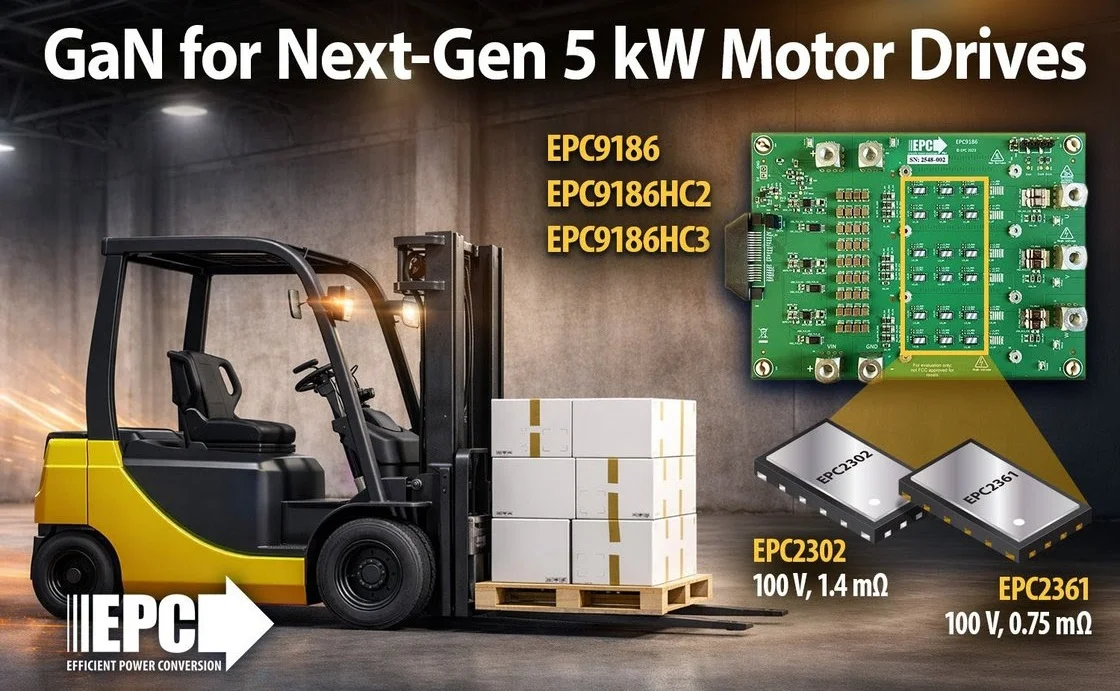
Both boards are based on EPC’s earlier EPC9186 platform, but use a new GaN power stage to improve conduction performance and support higher current operation. The EPC9186HC2 uses two EPC2361 devices in parallel per switch position, while the EPC9186HC3 uses three, giving engineers two options for evaluating higher-current inverter designs.
Higher Current From The Same Basic Platform
The EPC9186HC2 and EPC9186HC3 keep the same general hardware architecture as the earlier EPC9186, but the updated power stage is the key change here. EPC says the new configuration supports higher current and lower cost operation in demanding motion-control applications, while still taking advantage of the faster switching behavior associated with GaN devices.
According to the press release, the boards support motor drive systems up to 5 kW, phase currents up to 150 A RMS depending on the current-sensing setup, and PWM switching frequencies up to 120 kHz. The official EPC board page lists the EPC9186HC2 at 130 A RMS and the EPC9186HC3 at 150 A RMS, with peak current ratings of 180 A and 200 A respectively. The same page lists a 14 V to 80 V DC input range.
Built For Demanding Motor-Control Work
EPC is positioning these boards for motion-control systems where size, current handling, and switching performance all matter at the same time. That includes robotics and industrial automation, but also smaller electric mobility platforms where inverter size and efficiency can quickly become design constraints.
The boards integrate the main functions needed for 3-phase inverter evaluation, including gate drivers, phase-current sensing, voltage monitoring, housekeeping power supplies, and protection features such as over-current detection and input undervoltage lockout. EPC’s board page also lists temperature monitoring, which is useful when evaluating inverter behavior at higher load conditions.
Support For Sensorless And Encoder-Based Control
EPC says the EPC9186HC2 and EPC9186HC3 support both sensorless and encoder-based motor control, and can be used with controller platforms from Microchip, Texas Instruments, and STMicroelectronics. That makes the boards easier to drop into existing development flows instead of forcing engineers into a closed control environment.
Integrated phase-current sensing also supports field-oriented control, which is important in systems where torque control and closed-loop stability need to be evaluated properly across a range of switching frequencies. For motor-control developers, that makes these boards more than simple power-stage demonstrators. They are intended as full evaluation platforms for testing how a GaN-based inverter behaves in real motion systems.
GaN Keeps Moving Further Into Motor Drives
The main point of these boards is not just that EPC has released another evaluation kit. It is that GaN is continuing to move into higher-current motor drive hardware where silicon MOSFETs have traditionally been the default choice. EPC is using the EPC9186HC2 and EPC9186HC3 to show that GaN can be applied to compact, high-efficiency 3-phase inverter designs for motion-control systems that need both fast switching and serious current capability.
For engineers working on robotics, compact traction systems, and other high-power BLDC designs, these boards offer a ready-made way to examine what that looks like in practice.
Learn more and read the original announcement at www.epc-co.com
Technology Overview
The EPC9186HC2 and EPC9186HC3 are 3-phase BLDC motor drive evaluation boards based on EPC2361 100 V eGaN FETs. EPC lists the HC2 at 130 A RMS and the HC3 at 150 A RMS, with a 14 V to 80 V DC input range and integrated current, voltage, and temperature monitoring.
Frequently Asked Questions
What are the EPC9186HC2 and EPC9186HC3 used for?
They are used to evaluate GaN-based 3-phase BLDC inverter designs for applications such as robotics, eMobility platforms, forklifts, and drones.
What is the difference between the EPC9186HC2 and EPC9186HC3?
The EPC9186HC2 uses two EPC2361 GaN FETs in parallel per switch position, while the EPC9186HC3 uses three. EPC lists the HC2 at 130 A RMS and the HC3 at 150 A RMS.
What input voltage range do the boards support?
EPC’s product page lists a 14 V to 80 V DC input range.
Related news
More from Efficient Power Conversion
Keep up with the components and technology shaping electronics.
Join the club for member features, engineering discussion and easier access to the latest Component Club content.