
New Laser-Based Wireless System Hits 360Gbps
Researchers have developed a new laser-based wireless system that achieves internet speeds exceeding 360Gbps, offering a potential alternative to traditional Wi-Fi. However, challenges such as line-of-sight requirements and deployment complexity remain. What makes this laser system different from Wi-Fi, how does it compare in terms of energy efficiency, and could it eventually replace traditional wireless technologies?
The Challenge With Wi-Fi and Energy
Wi-Fi is a fantastic technology, and has really defined portable computing. With the use of Wi-Fi, a user can have access to the internet, connect to other devices, and even share files between different machines.
However, for all the positives that Wi-Fi brings, there are some real challenges that it faces. The first, and most obvious, is that Wi-Fi is very power hungry. While this is not an issue when Wi-Fi is used in a stationary location, such as a home office, this can quickly lead to reduced battery life for devices that need to operate remotely.
The second challenge that Wi-Fi faces is its speed. While Wi-Fi is able to achieve very high data rates, newer technologies such as 5G are starting to suffer from interference and range issues. This can make it difficult for Wi-Fi to penetrate walls and spread throughout a living space, which is why many Wi-Fi networks require repeaters to help with signal strength.
The third challenge that Wi-Fi faces is the sheer number of Wi-Fi networks currently in use, leading to a problem called “Wi-Fi starvation”. If there are too many Wi-Fi networks in a given area, it can be difficult for a device to find an open frequency to connect to.
Researchers Break 360Gbps Barrier Using Lasers
A major breakthrough in wireless technology could see internet speeds significantly increase while reducing energy consumption in wireless technology by eliminating the use of radio waves in favour of light. The new technology uses a tiny chip with dozens of miniature lasers that can transmit massive amounts of data simultaneously, and initial tests of the technology have seen speeds exceeding 360 gigabits per second.
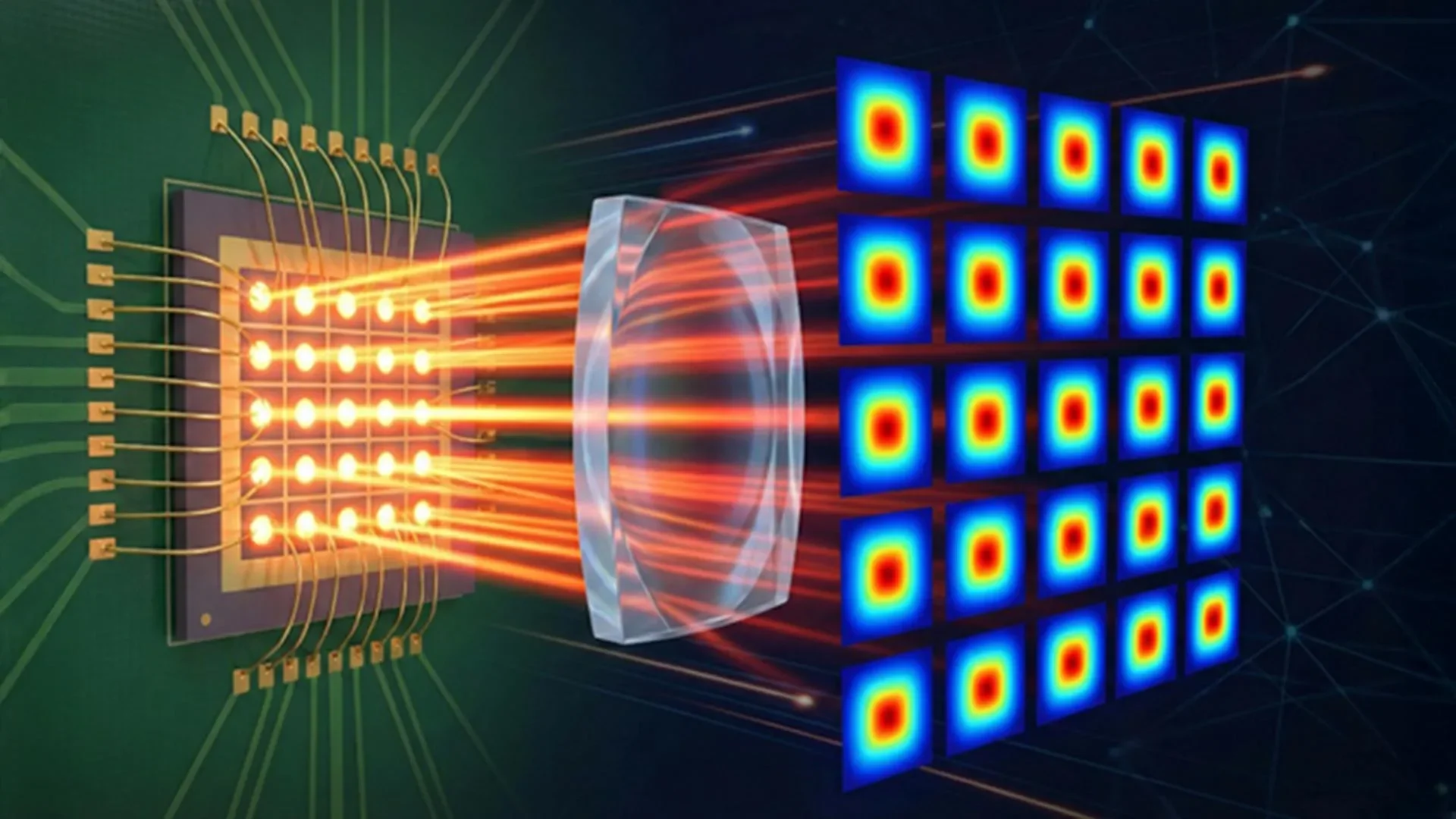
The new technology, called optical wireless communication, provides more available bandwidth than existing Wi-Fi technologies, does not interfere with existing wireless systems, and can be directed with high precision. It is based on a 5x5 array of vertical-cavity surface-emitting lasers (VCSELs), which are efficient, operate at high speeds, and can be manufactured in large arrays using standard semiconductor fabrication techniques. Each laser in the array can be controlled independently and transmit its own stream of data.
In testing, the system achieved data rates exceeding 360 gigabits per second over a two-meter optical link using 21 active lasers, with each channel running between 13 and 19 gigabits per second. The team also developed an optical arrangement to prevent overlap and interference between beams. The lenses organize the beams into a structured grid of square illumination areas so that each beam covers a specific region of space with minimal overlap.
To examine energy efficiency, the team compared the optical wireless system with typical Wi-Fi platforms. Their results showed energy use of around 1.4 nanojoules per bit transmitted, roughly half that of leading Wi-Fi technologies under similar conditions.
Are Lasers Really The Future?
Lasers are excellent for use in wireless communication due to their ability to provide high speed communications at long ranges, and they also lack the interference issues that Wi-Fi suffers from. However, due to their requirement for a line of sight, they are far from trivial to deploy, and as such any light-based wireless system would require tracking and steering.
Various frequencies of light can be used to increase bandwidths, but this introduces its own range of issues, including the need for similar but separate frequencies, ability to control these frequencies with precision, and eliminating interference. Furthermore, the light used cannot be visible as this may cause issues with people in the space.
Overall, what the researchers have demonstrated is really impressive, but for the time being, Wi-Fi will remain the most viable technology.

Related news
More from Robin Mitchell
Keep up with the components and technology shaping electronics.
Join the club for member features, engineering discussion and easier access to the latest Component Club content.