Toshiba SmartMCD Integrates BLDC Motor Control for Cars
Toshiba has started sampling the TB9M030FG SmartMCD, combining an Arm Cortex-M0 MCU, gate driver, and LIN transceiver for low-speed sensorless FOC of three-phase BLDC motors in automotive pumps, fans, blowers, and related ECUs.
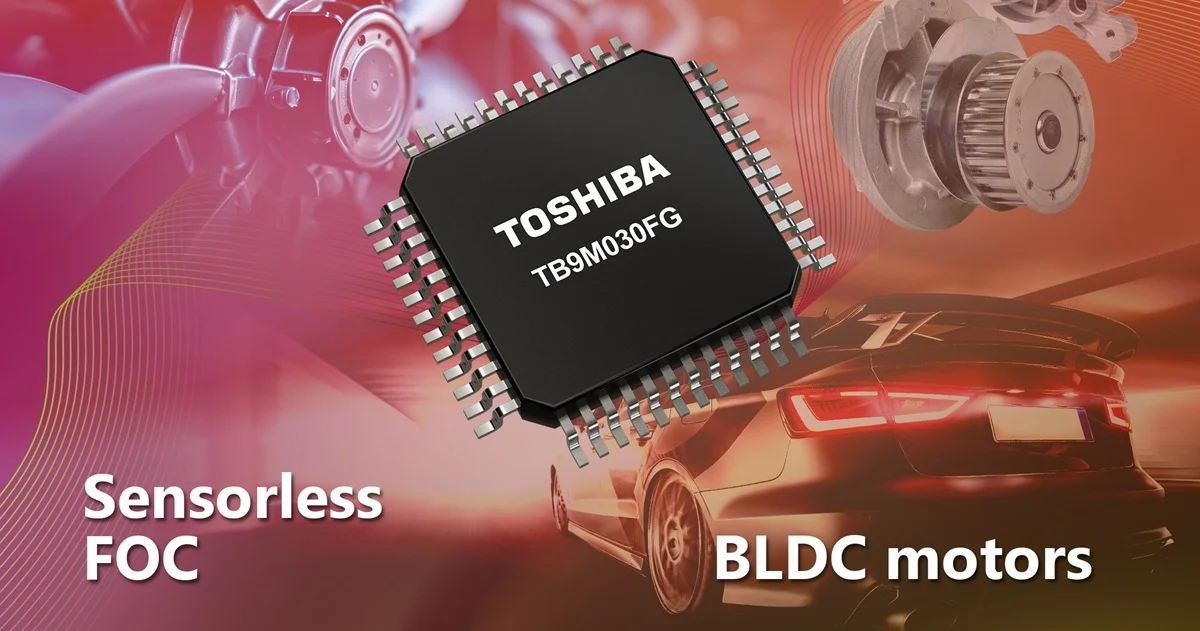
TB9M030FG is an automotive motor control device used for sensorless control of three-phase BLDC motors in vehicle subsystems. In a typical design, it sits in the ECU alongside the external N-channel MOSFET stage and handles the control and drive functions needed to run the motor from the vehicle battery rail.
SmartMCD Integration Around the Motor Control Stage
The main point of the part is integration. Toshiba has combined a 32-bit MCU based on an Arm Cortex-M0 core with flash, ROM, RAM, a gate driver for three-phase BLDC operation, a LIN transceiver, and a power system that can operate at automotive battery levels. That pulls several control and interface blocks into one device, which helps reduce board space in motor control ECUs that are already under pressure to become smaller as more electrified functions move into the vehicle.
The memory configuration is modest but appropriate for this class of controller. Toshiba lists 64 kB of flash, 12 kB of ROM, and 4 kB of RAM, which is enough to make clear that this part is aimed at tightly scoped embedded motor tasks rather than large software-heavy control platforms. The package is a 9 mm × 9 mm QFP48, so the integration story is not just about reducing BOM count. It is also about keeping the control hardware physically compact enough for dense automotive assemblies.
Low-Speed Sensorless FOC Without Injection Noise
The more interesting technical detail is how Toshiba is positioning the device for low-speed sensorless control. The company says the TB9M030FG supports position FOC control from zero speed through the low-speed range when paired with optimized PM-synchronous motors that have magnetic anisotropy in the rotor. That matters because low-speed sensorless BLDC control is usually where rotor position estimation becomes harder and where control quality can start to break down.
Toshiba also says its control method avoids the harmonic injection noise associated with conventional high-frequency injection approaches. That gives the part a clearer use case in automotive pumps and fans, where acoustic behavior is not a secondary concern. A quieter motor control scheme is often just as relevant as efficiency when the target system operates continuously or sits close to the cabin environment.
Vector Engine Support and ECU Reduction
The device also includes Toshiba’s vector engine co-processor, which is there to shorten FOC cycle times while reducing CPU workload and software size in motor control applications. Toshiba’s official announcement adds that the device includes built-in current sensing support and A/D conversion resources, which fits with the broader idea of moving more of the control loop into a single motor-control device.
Taken together, the TB9M030FG looks less like a simple motor driver update and more like a compact control platform for specific automotive auxiliaries. It does not try to cover every motor application, but for three-phase BLDC systems that need low-speed sensorless control, LIN connectivity, and a smaller ECU footprint, the integration level is the main reason to pay attention to it.
Learn more and read the original announcement at www.toshiba.semicon-storage.com
Technology Overview
The Toshiba TB9M030FG is an AEC-Q100 Grade 0 SmartMCD device that integrates a 32-bit Arm Cortex-M0 MCU, three-phase BLDC gate driver, LIN transceiver, and onboard power support for automotive battery-level operation. It is designed for sensorless FOC control of three-phase BLDC motors in automotive systems and is packaged in a 9 mm × 9 mm QFP48.
Frequently Asked Questions
What is the Toshiba TB9M030FG used for?
It is used for sensorless control of three-phase BLDC motors in automotive applications such as electric water pumps, oil pumps, fans, and blowers.
Does the TB9M030FG include both MCU and motor driver functions?
Yes. It integrates a 32-bit MCU, gate driver, LIN transceiver, and automotive power support in one device.
What package does the TB9M030FG use?
Toshiba lists the device in a QFP48 package measuring 9 mm × 9 mm typical.
Related news
More from Toshiba
Keep up with the components and technology shaping electronics.
Join the club for member features, engineering discussion and easier access to the latest Component Club content.