
Toshiba TLX9920 Photocoupler for Isolated SSR Gate Drive
Toshiba’s TLX9920 is a photovoltaic-output photocoupler for isolated MOSFET gate drive in SSR designs, targeting automotive and industrial systems with 8 mm creepage, 5000 Vrms isolation, and AEC-Q101 qualification.
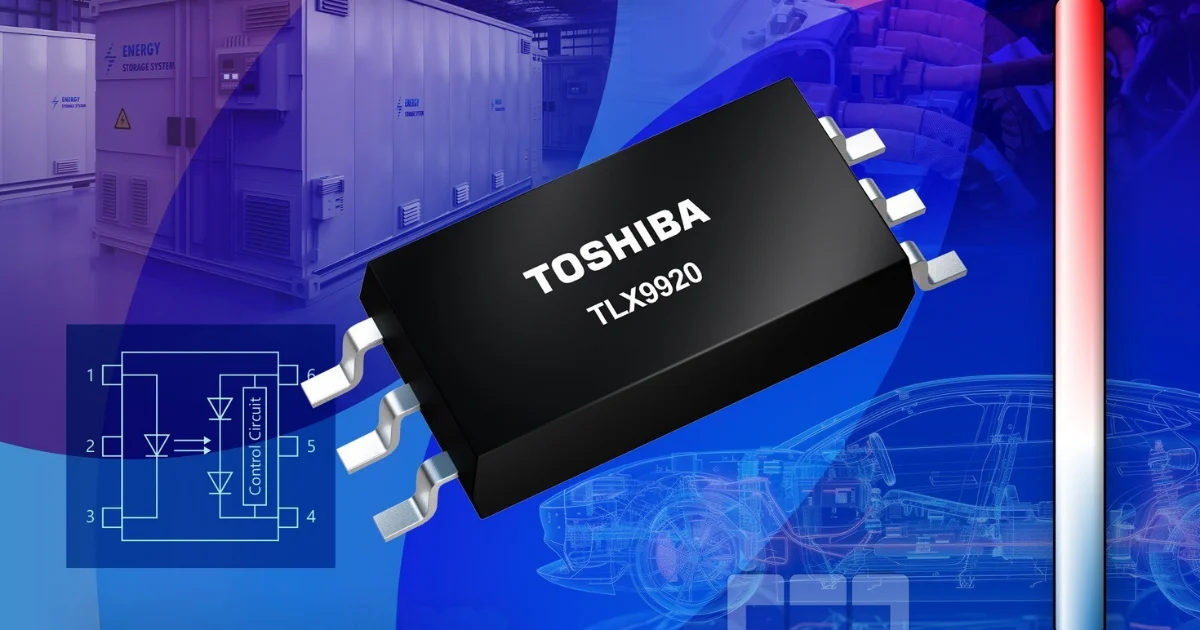
The part is intended for SSR stages built around external MOSFETs rather than integrated photorelays. That gives designers a way to handle the isolation barrier and the MOSFET gate drive without adding a separate secondary-side supply, which is really the main point here. Toshiba is targeting applications such as battery management systems, onboard chargers, inverters, ESS hardware, and other control circuits where solid-state switching is starting to displace mechanical relays.
A Simpler Route To Driving SSR MOSFETs
The TLX9920 is a photovoltaic-output photocoupler used to generate gate drive for external MOSFETs across an isolation barrier. In a real system, that places it between the low-voltage control side and the higher-voltage switching side, where it can support MOSFET drive in relay paths that need electrical isolation and longer service life than a mechanical relay can usually offer.
That matters most in designs where the isolation barrier is already eating board space and the gate-drive section is turning into its own little subsystem. If the isolated side does not need a separate supply, the SSR stage becomes a bit easier to place, route, and manage. In high-voltage designs, that kind of simplification is often more useful than it sounds on paper.
Package, Creepage, And Isolation Rating
Physically, the TLX9920 comes in Toshiba’s thin SO6L package at 3.84 mm × 10.0 mm × 2.1 mm. More importantly, it brings 8 mm creepage and a minimum isolation rating of 5000 Vrms, so it is clearly aimed at higher-voltage designs where spacing and insulation requirements start shaping the layout early. Toshiba also lists the device as AEC-Q101 qualified, which puts it in a more usable position for automotive programs from the start.
Those numbers matter because the relay section is often sitting right at the point where low-voltage control has to reach into a much higher-voltage subsystem without creating layout or safety headaches. In battery-connected automotive systems, onboard chargers, and industrial power control hardware, creepage distance is not a small packaging detail. It often decides how compact the overall switching section can realistically be.
Built Around External MOSFET Flexibility
One useful aspect of this approach is that Toshiba is not trying to make the TLX9920 a complete relay by itself. It is there to drive external high-voltage MOSFETs, which gives designers more freedom when current rating, voltage class, or switching arrangement push beyond what a conventional photorelay can comfortably handle.
That is particularly relevant in back-to-back MOSFET configurations, where designers are trying to block current in both directions while keeping control circuitry isolated from the power path. The device also includes an integrated discharge circuit, which helps with reliable turn-off behavior and keeps the surrounding gate-drive network from becoming more involved than it needs to be.
Where The TLX9920 Fits
The most obvious fit for the TLX9920 is in solid-state relay sections used in battery management systems, onboard chargers, inverters, ESS equipment, and other industrial switching hardware where relay lifetime and isolation both matter. These are not exotic edge-case applications. They are the kinds of circuits where mechanical relays increasingly look like the least attractive part of the design. So this is a fairly focused release, but it is focused in the right way. The TLX9920 is not being presented as a general-purpose isolator or a broad signal-coupling device. It is a gate-drive photocoupler for SSR architectures that need reinforced isolation, automotive-grade reliability, and a cleaner way to handle high-side or back-to-back MOSFET switching.
Learn more and read the original announcement at www.toshiba.semicon-storage.com
Technology Overview
The Toshiba TLX9920 is a photovoltaic-output photocoupler for isolated gate drive in solid-state relay circuits using external MOSFETs. It comes in a thin SO6L package with 8 mm creepage distance and a minimum isolation voltage of 5000 Vrms, and Toshiba positions it for automotive and industrial high-voltage systems including BMS, onboard chargers, inverters, and ESS equipment. The device is also listed as AEC-Q101 qualified and includes an integrated discharge circuit for turn-off support.
View the part number/name datasheet
Frequently Asked Questions
What is the TLX9920 used for?
It is used as an isolated gate driver for external power MOSFETs in solid-state relay circuits, including high-side and back-to-back MOSFET configurations.
Does the TLX9920 need a secondary-side power supply?
Toshiba positions it as a photovoltaic-output photocoupler that generates gate drive voltage directly, so it is intended to avoid the need for a separate secondary-side supply in the SSR gate-drive stage.
What isolation and package details does the TLX9920 offer?
The TLX9920 uses a thin SO6L package with 8 mm creepage distance and a minimum isolation voltage of 5000 Vrms.
Related news
More from Toshiba
Keep up with the components and technology shaping electronics.
Join the club for member features, engineering discussion and easier access to the latest Component Club content.