TDK Targets X-By-Wire Motor Control With ASIL D Hall Sensor
TDK has introduced the HAL 3025 fast Hall sensor for x-by-wire motor control systems, combining 60,000 rpm operation, analog sine/cosine outputs, stray-field compensation, and ASIL D readiness.
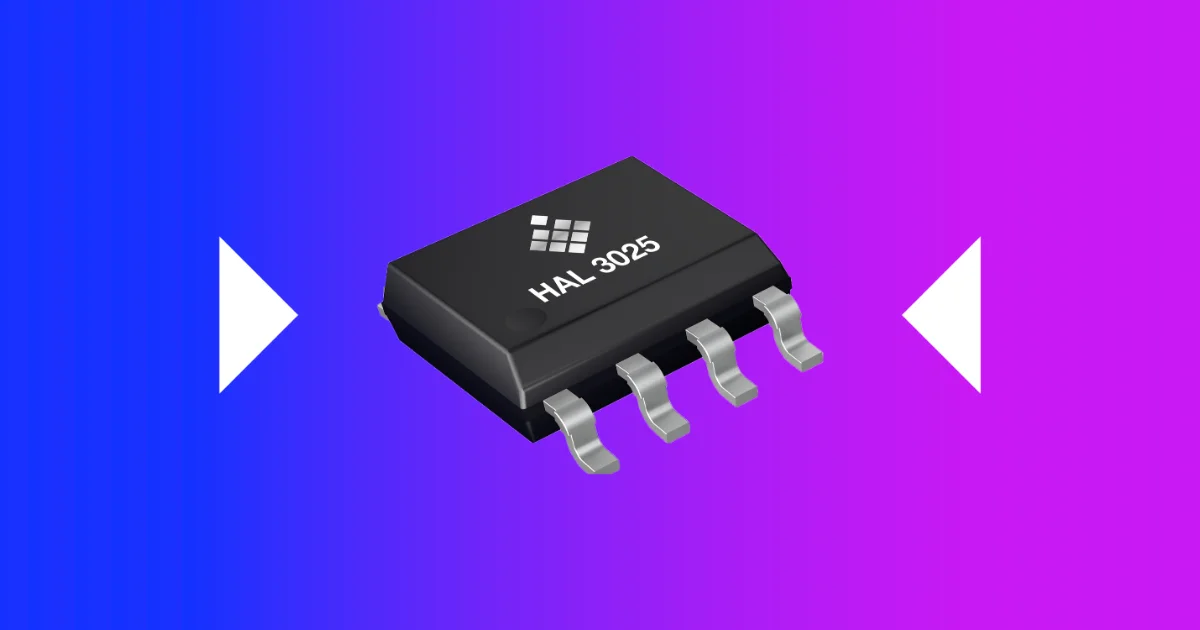
The HAL 3025 is a 360° Hall-based rotary position sensor for BLDC, PMSM, and AC induction motor control systems. The device uses TDK-Micronas SixSense technology to measure the vertical magnetic field component while compensating for external magnetic stray fields that would normally interfere with position sensing accuracy in electrically noisy environments.
TDK says the sensor is intended for EV traction motors, steer-by-wire systems, brake-by-wire systems, and other safety-critical motor applications operating at rotational speeds up to 60,000 rpm.
Stray-Field Compensation For Compact Motor Layouts
One of the larger challenges in modern EV motor systems is sensor placement near power electronics. Once inverter stages, switching currents, and high-power wiring move close to the sensing element, magnetic interference becomes much harder to control. The HAL 3025 suppresses both DC and AC magnetic stray fields according to ISO 11452-8. That allows the sensing element to operate closer to surrounding power circuitry without relying on oversized magnets or additional shielding structures.
TDK says a simple two-pole ferrite magnet in an end-of-shaft configuration is sufficient for operation. Reducing shielding and magnet size can help simplify the wider motor layout, especially in compact steer-by-wire and braking systems where packaging space is already limited.
Analog Sine And Cosine Outputs For Fast Response
The HAL 3025 uses differential or single-ended analog sine and cosine outputs, allowing external microcontrollers or ECUs to calculate absolute angular position with high resolution.
The analog signal path is designed for fast response and high output bandwidth, which becomes more important as motor speeds increase. TDK specifies operation up to 60,000 rpm with configurable delay times between 4.6 µs and 40.4 µs.
The device also includes programmable signal-path adjustment through on-chip non-volatile memory. Parameters including gain, offset, orthogonality, magnetic bandwidth, and zero-angle alignment can all be configured through the sensor output pin without requiring additional programming connections.
ASIL D Ready Architecture
The HAL 3025 is positioned as an SEooC ASIL D ready device developed according to ISO 26262:2018. TDK uses a single-die failsafe architecture with integrated diagnostics including wire-break monitoring, overvoltage and undervoltage detection, and other internal safety functions intended to reduce external supervision requirements at the ECU level.
The sensor operates across a junction temperature range from -40°C to 170°C and is supplied in an SOIC8 package. TDK also notes that the footprint is pin-compatible with the earlier HAL 3020 and HAL 3021 devices, allowing existing designs to move toward higher safety requirements without major PCB redesign.
Samples of the HAL 3025 are already available, with production planned for Q2 2026.
Learn more and read the original announcement at www.micronas.tdk.com
Technology Overview
The HAL 3025 is a Hall-effect rotary position sensor for high-speed motor control applications including EV traction motors, steer-by-wire systems, and brake-by-wire systems. The device supports 360° angle measurement with analog sine/cosine outputs and rotational speeds up to 60,000 rpm. The sensor includes magnetic stray-field compensation according to ISO 11452-8 and is positioned as an SEooC ASIL D ready device according to ISO 26262:2018. It operates from -40°C to 170°C junction temperature and is supplied in an SOIC8 package.
Frequently Asked Questions
What applications is the HAL 3025 designed for?
The sensor is intended for EV traction motors, steer-by-wire systems, brake-by-wire systems, and other high-speed motor control applications.
What output format does the HAL 3025 use?
The device provides differential or single-ended analog sine and cosine outputs for angular position calculation.
What rotational speeds does the HAL 3025 support?
TDK specifies operation at rotational speeds up to 60,000 rpm.
Related news
More from TDK
Keep up with the components and technology shaping electronics.
Join the club for member features, engineering discussion and easier access to the latest Component Club content.