u-blox Adds ZED-X20K And ZED-A20K GNSS Modules For ADAS
u-blox has introduced the ZED-X20K and ZED-A20K automotive GNSS modules for ADAS and autonomous driving, combining high-accuracy positioning, Galileo HAS support, and functional safety options.
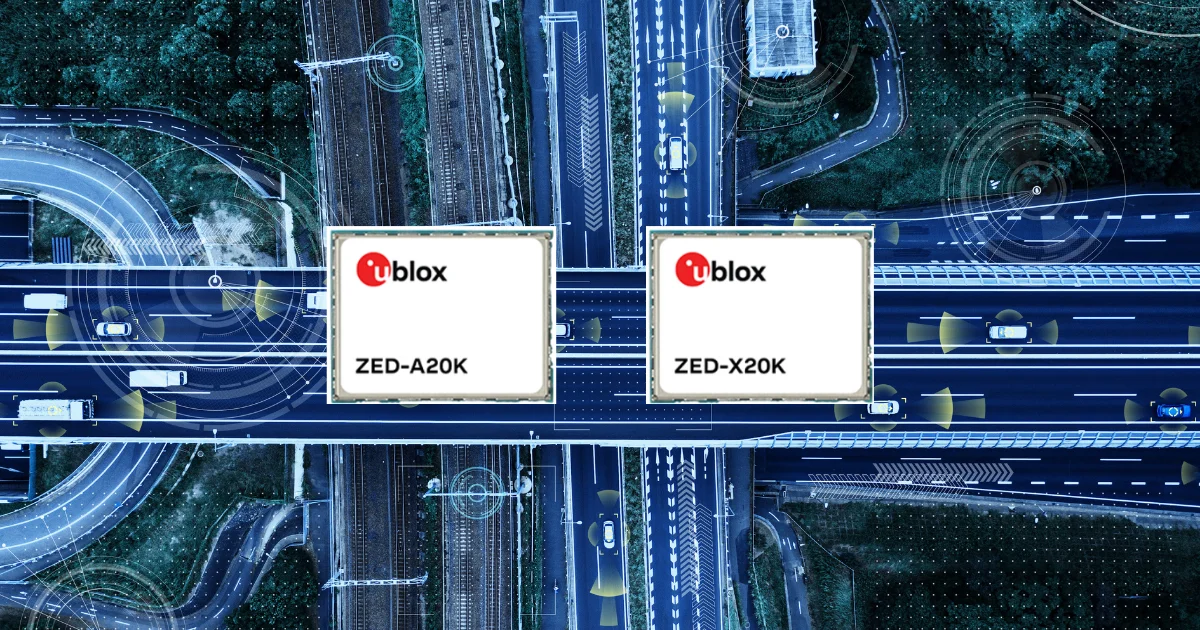
ZED-X20K and ZED-A20K are automotive GNSS modules used to provide high-accuracy vehicle positioning in ADAS and autonomous driving systems. They are pin-to-pin compatible, so OEMs and Tier 1 suppliers can use the same socket while choosing between a high-accuracy positioning module and a functional safety-focused version. Both modules also include jamming and spoofing detection.
Two GNSS Modules For Different ADAS Requirements
The ZED-X20K is positioned for mass-market ADAS L2+ and L3 use cases where lane-level positioning is needed without adding correction service management on top of the hardware. It uses all-band GNSS and native Galileo High Accuracy Service support to deliver high-accuracy positioning worldwide.
That service model is a practical part of the launch. Correction services can add cost, regional variation, backend infrastructure, and ongoing management to a vehicle program. By using Galileo HAS directly, the ZED-X20K is intended to reduce that overhead while still supporting global high-accuracy positioning.
For vehicle platforms that need a functional safety concept around GNSS, u-blox is introducing the ZED-A20K. This module is aimed at L3 and L4 systems where positioning integrity becomes part of the wider safety architecture rather than a standalone navigation feature.
ZED-A20K Targets Functional Safety Architectures
The ZED-A20K provides ISO 26262 ASIL-B(D)-compliant GNSS RAW data at the same time as high-performance QM positioning outputs. u-blox says this allows OEMs to move away from traditional dual hardware GNSS architectures in some designs and use a single-module approach instead. That distinction is important because functional safety requirements can make localization hardware more complex very quickly. A dual-GNSS setup may help meet safety objectives, but it also adds cost, board space, validation work, and integration effort. A single-module architecture can simplify the design if the system concept supports it.
The module also supports externally hosted positioning engines, which fits software-defined vehicle architectures where more of the positioning stack may be handled outside the GNSS module itself.
Shared Form Factor Helps Vehicle Platform Scaling
Pin-to-pin compatibility between the ZED-X20K and ZED-A20K gives automakers a cleaner path for platform scaling. A vehicle program could use the ZED-X20K where high-accuracy positioning is needed without functional safety requirements, then move to the ZED-A20K for trims or platforms that need the added safety architecture.
That keeps the mechanical and electrical integration more consistent across vehicle generations. For Tier 1 suppliers, it can also reduce redesign work when supporting multiple customer platforms with different ADAS requirements. The ZED-X20K has reached Engineering Sample stage, with an evaluation kit available now. Samples of the ZED-A20K are expected to be available from August 2026.
Learn more and read the original announcement at www.u-blox.com
Technology Overview
The u-blox ZED-X20K and ZED-A20K are automotive GNSS modules for high-accuracy positioning in ADAS, TCU, IVI, and autonomous driving systems. ZED-X20K supports global lane-level positioning using all-band GNSS and native Galileo High Accuracy Service, while ZED-A20K provides ISO 26262 ASIL-B(D)-compliant GNSS RAW data alongside QM positioning outputs. Both modules are pin-to-pin compatible and include jamming and spoofing detection.
Frequently Asked Questions
What is the difference between ZED-X20K and ZED-A20K?
ZED-X20K is designed for scalable high-accuracy positioning in ADAS, TCU, and IVI applications, while ZED-A20K adds a functional safety architecture for L3 and L4 autonomous driving systems.
Does ZED-X20K require paid correction services?
According to u-blox, ZED-X20K uses native Galileo High Accuracy Service and does not require paid correction services, backend infrastructure, or service management.
When will the ZED-A20K be available?
u-blox says samples of the ZED-A20K will be available from August 2026.
Related news
More from u-blox
Keep up with the components and technology shaping electronics.
Join the club for member features, engineering discussion and easier access to the latest Component Club content.