
Texan Researchers 3D Print Key Battery Part in Any Shape
Recently, researchers from University of Texas showed how a lithium-based electrolyte could be 3D printed into any shape. How could this technique change how batteries are made, and where could it be useful?
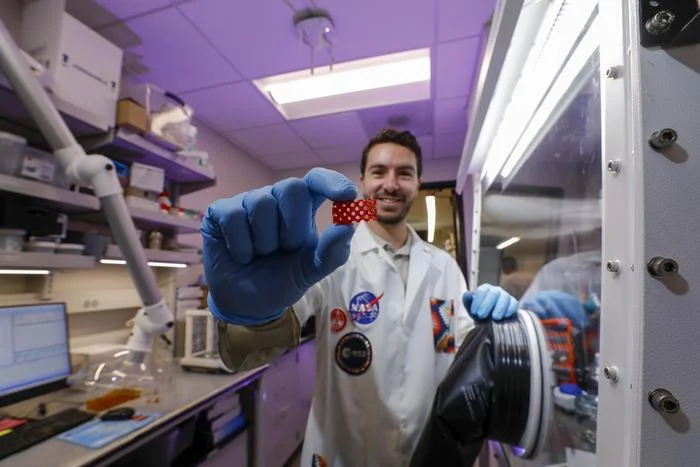
University of Texas Researchers 3D Print Battery Electrolyte
Recently, researchers from the University of Texas at El Paso published a paper regarding a newly developed technique for creating 3D printable gel polymer electrolytes. The idea behind the technology is to allow battery components to be manufactured in virtually any 3D shape as opposed to using pre-made battery containers (which often come in standard rectangular shapes).
To create the printable electrolyte, the researchers combined a light-curable resin with a lithium-based liquid electrolyte. From there, the mixture was then fabricated using vat photopolymerization (i.e. similar to SLA), thereby eliminating the need for a liquid-filled rigid battery casing.
After experimenting with various concentrations, the researchers discovered that a 1:4 ratio of resin to electrolyte provided the best results. This concentration provided an ionic conductivity of up to 3.4 × 10⁻³ S/cm which is on par with other gel electrolytes manufactured using conventional methods.
However, what makes the research unique is that their electrolyte can be printed in normal laboratory air instead of requiring an oxygen-free environment. This significantly reduces the complexity of manufacturing batteries using the new technology.
Finally, the researchers demonstrated their ability to print the new electrolyte by constructing multiple geometries including a disc, honeycomb lattices, and a solid cube. According to the researchers, these shapes demonstrate how future batteries could be integrated into products to provide custom energy storage solutions. Such applications include wearables, medical implants, and aerospace vehicles.
Where Could Such Technology Be Useful?
The idea of being able to print a battery's electrolyte into virtually any 3D shape presents numerous opportunities across many industries.
Of course, the ability to create unique batteries that are designed to fit an enclosure perfectly would be massively beneficial for smaller, more portable devices. The same applies to products that need to make the most of every available cubic millimeter. A battery that conforms to the internal shape of a device can maximize the available volume, increasing the amount of energy that can be stored without increasing the overall size of the product.
However, where this technology could become particularly valuable is future spaceflight and long-term space colonization. Instead of manufacturing complete batteries on Earth and launching them into space, only the raw materials and a suitable 3D printer would need to be transported. When new batteries are required, they could be manufactured on demand for virtually any application. Large batteries for long-term energy storage could be produced alongside smaller batteries for tools, scientific instruments, vehicles, and other equipment.
But it may even go further than that. The same manufacturing techniques could eventually be adapted to produce supercapacitors and other energy storage components. Future missions will need to be as self-sufficient as possible, and the ability to manufacture a range of energy storage devices as required could significantly reduce dependence on replacement parts shipped from Earth.
There is no doubt that technologies such as this have the potential to change how batteries are designed and integrated into products. As electronics become more compact and mechanically complex, trying to fit bulky, standardized battery packs into enclosures will become increasingly restrictive.
The ability to manufacture battery components in almost any shape could give engineers far greater freedom when designing next-generation products while making much better use of the space available.

Related news
More from Robin Mitchell
Keep up with the components and technology shaping electronics.
Join the club for member features, engineering discussion and easier access to the latest Component Club content.