
MaxLinear Launches Puma 9 for DOCSIS 3.1+ and 4.0 Gateways
MaxLinear launches its 8 nm Puma 9 platform, supporting DOCSIS 3.1, 3.1+ and 4.0 with five OFDM channels, up to 12 Gbps downstream, DDR5 and integrated edge-AI processing.
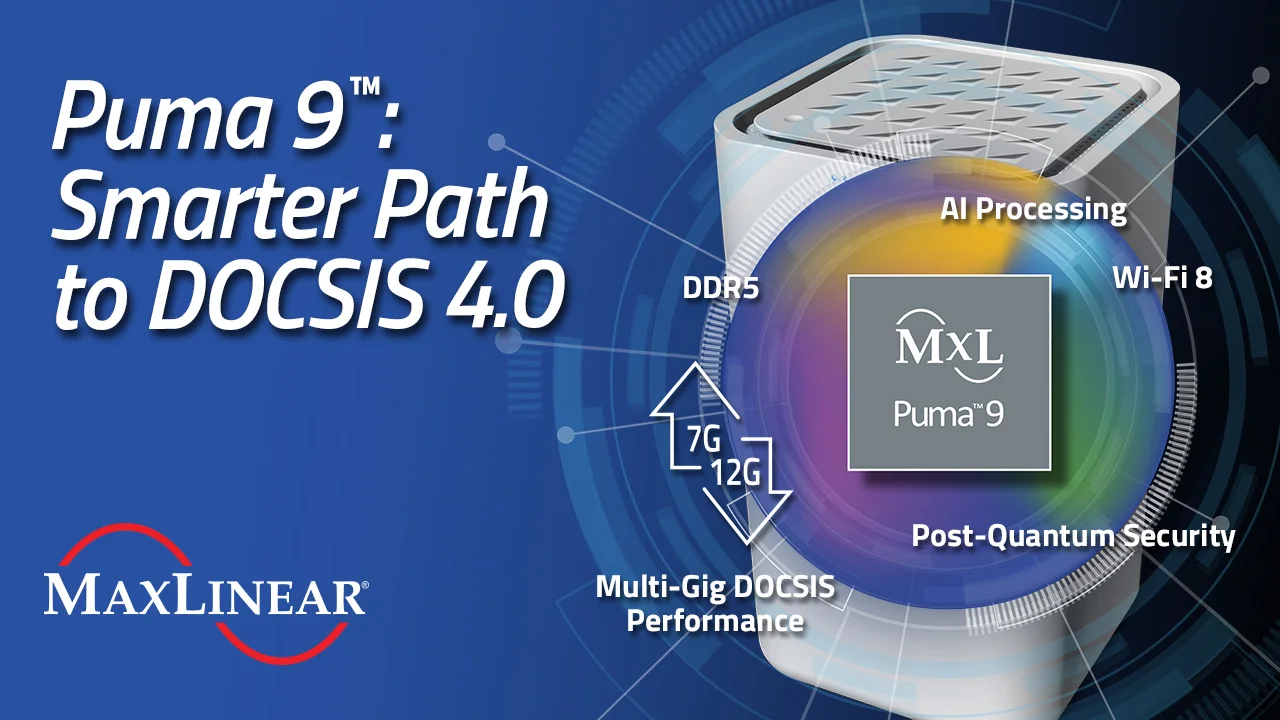
The new platform is designed to give operators and equipment manufacturers more flexibility over how broadband gateways are deployed as cable networks move toward higher speeds. Rather than building hardware around one DOCSIS configuration, Puma 9 can initially be deployed on existing infrastructure and later reconfigured in the field as network requirements change.
That also gives DOCSIS 3.1 networks room to develop before a full move to DOCSIS 4.0. Puma 9 supports five OFDM channels, allowing operators to increase downstream capacity while retaining their existing DOCSIS infrastructure.
Taking DOCSIS 3.1 Beyond 10 Gbps
With five OFDM channels, Puma 9 can deliver more than 10 Gbps downstream over DOCSIS 3.1. MaxLinear puts the figure at up to 12 Gbps when the platform is configured for DOCSIS 3.1+, creating an intermediate step between today's deployments and DOCSIS 4.0.
The same Puma 9 hardware can then support DOCSIS 4.0 through an in-field upgrade. For gateway manufacturers, this means one hardware platform can cover products intended for different stages of the network transition instead of requiring separate designs for each DOCSIS generation.
MaxLinear has also moved Puma 9 to DDR5 memory. This is partly about supporting the performance of newer gateway designs, but there is a practical supply consideration too. DDR4 is moving further into its lifecycle as memory manufacturers shift production toward DDR5, something that becomes important when designing broadband equipment expected to remain in production and service for several years.
Processing More at the Edge
Puma 9 also brings more processing into the gateway itself. An integrated NPU based on MaxLinear's MaxAI technology can handle edge-AI workloads, with the company identifying network optimization and quality-of-service management among the intended applications.
The platform is designed to work alongside future Wi-Fi 8 connectivity, extending the processing available behind the wireless side of the gateway as home networks become more complex.
Security has been considered over the expected lifetime of the hardware as well. Puma 9 is post-quantum cryptography ready, with MaxLinear also targeting requirements including NIST IR 8425A, the EU Radio Equipment Directive and Cyber Resilience Act.
Taken together, the important change with Puma 9 is not any one of those additions. It is the ability to build a gateway around one silicon platform while the access network, memory technology, wireless connectivity and security requirements around it continue to develop.
Puma 9 is available now to broadband operators and OEMs developing DOCSIS gateways and eMTA equipment.
Learn more and read the original announcement at maxlinear.com.
Technology Overview
MaxLinear Puma 9 is an 8 nm DOCSIS platform for broadband gateways and eMTA systems. It supports DOCSIS 3.1, 3.1+ and 4.0 on the same hardware, allowing systems to move between configurations through in-field upgrades. The platform supports five OFDM channels and up to 12 Gbps downstream in DOCSIS 3.1+ mode, alongside DDR5 memory, an integrated MaxAI-powered NPU and post-quantum cryptography readiness.
FAQs
What DOCSIS versions does MaxLinear Puma 9 support?
Puma 9 supports DOCSIS 3.1, 3.1+ and 4.0 on a single platform. MaxLinear says equipment can move between configurations through in-field upgrades rather than requiring different hardware for each DOCSIS generation.
How fast is Puma 9 in DOCSIS 3.1+ mode?
Puma 9 supports five OFDM channels and up to 12 Gbps downstream throughput in a DOCSIS 3.1+ configuration.
Why does Puma 9 support DDR5?
MaxLinear has moved the platform to DDR5 as memory manufacturers transition away from DDR4. This is intended to improve memory sourcing flexibility and support the longer product lifecycles expected for broadband gateway hardware.
Related news
More from Max Linear
Keep up with the components and technology shaping electronics.
Join the club for member features, engineering discussion and easier access to the latest Component Club content.