
TDK Expands MLJ1608-G Inductors for 2 GHz Automotive PoC
TDK expands its MLJ1608-G automotive PoC inductor series with a 1.25 µH multilayer device offering high impedance up to 2 GHz in a compact 1608 package with AEC-Q200 compliance.
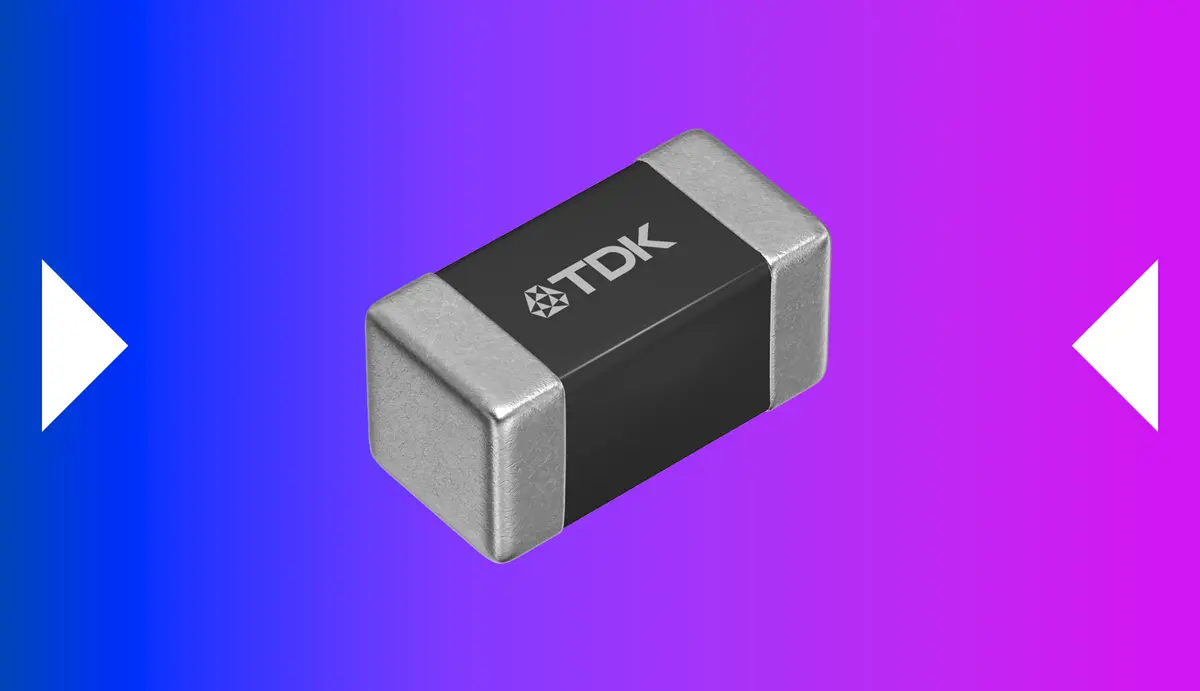
TDK has expanded its MLJ1608-G multilayer inductor series for automotive power-over-coax circuits, adding a 1.25 µH device with high impedance up to 2 GHz in a compact 1608 package.
Mass production of the MLJ1608WGC1R2MTD25 began in October 2026. The AEC-Q200-compliant device is designed for the wideband filters used to separate power and data in automotive camera PoC connections.
PoC allows both functions to share a single coaxial cable between an automotive camera and electronic control unit. The filter on that connection has to maintain sufficient impedance across a broad frequency range while fitting within increasingly compact camera modules.
Higher Impedance Across Automotive PoC Frequencies
TDK has increased the inductance of the new MLJ1608-G device to 1.25 µH ±20% at 25 MHz. The company compares this with 0.56 µH for its conventional components.
According to TDK, the higher inductance and its material and structural design give the series high impedance across frequencies from 300 MHz to 2 GHz. Between 100 and 700 MHz, TDK specifies impedance around 1.7 to two times higher than its conventional components.
The increased impedance is intended to improve noise suppression within the PoC filter, where several inductors may be used to separate the DC power path from high-speed camera data.
Maintaining that performance across a wide frequency range becomes important as automotive camera systems carry increasing amounts of data while continuing to share the same coaxial connection for power.
1608 Package for Automotive Camera Modules
The MLJ1608WGC1R2MTD25 measures 1.6 × 0.8 × 0.8 mm and uses TDK’s multilayer processing technology to achieve the higher inductance within the compact footprint.
The device has a typical DC resistance of 0.81 Ω and a maximum of 1.20 Ω. Rated current is 350 mA at +105 °C and 200 mA at +125 °C.
TDK is continuing to develop inductors for automotive PoC applications using multilayer, wire-wound and thin-film technologies. The different construction methods give the company options for addressing the impedance requirements found across different parts of wideband PoC filters.
The new MLJ1608-G device is intended primarily for PoC circuits connecting automotive cameras used in advanced driver-assistance systems.
Learn more and read the original announcement at TDK.com.
Technology Overview
The TDK MLJ1608WGC1R2MTD25 is an AEC-Q200-compliant multilayer inductor for automotive power-over-coax circuits. It provides 1.25 µH ±20% inductance at 25 MHz in a 1.6 × 0.8 × 0.8 mm package and is designed for high impedance across PoC frequencies up to 2 GHz. TDK specifies 1.7 to two times higher impedance than its conventional components between 100 and 700 MHz.
FAQs
What is the TDK MLJ1608WGC1R2MTD25 designed for?
The device is designed for wideband filters in automotive power-over-coax circuits, particularly those connecting vehicle cameras to electronic control units.
What frequency range does the new MLJ1608-G inductor support?
TDK says the series provides high impedance from 300 MHz to 2 GHz. Between 100 and 700 MHz, the company specifies 1.7 to two times higher impedance than its conventional components.
Is the MLJ1608WGC1R2MTD25 qualified for automotive use?
Yes. The device is AEC-Q200 compliant and is rated for up to 350 mA at +105 °C or 200 mA at +125 °C.
Related news
Keep up with the components and technology shaping electronics.
Join the club for member features, engineering discussion and easier access to the latest Component Club content.