
A Robot Has Started Building an Antenna in Space
Caltech researchers have demonstrated robotic construction in orbit for the first time, assembling part of an antenna without astronauts. The experiment has also revealed how difficult it can be to operate assembly machinery hundreds of kilometres above Earth.
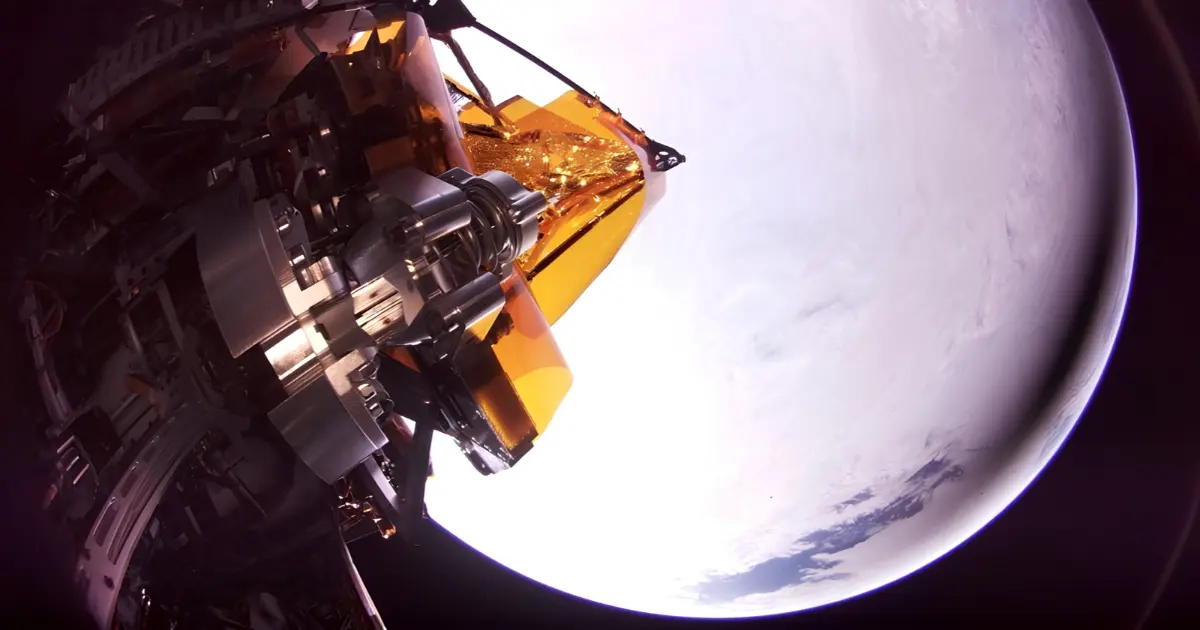
Caltech's ASTRA robot has successfully assembled part of an antenna structure in orbit, demonstrating a new approach to building large spacecraft structures without astronauts. The experiment used individual composite tubes and aluminium joints to construct an additional section of the antenna's framework.
The achievement was announced by Caltech on November 5 following six months of experiments aboard a spacecraft in low Earth orbit. The system, known as ASTRA, was developed under a programme funded by the US Defense Advanced Research Projects Agency (DARPA), which is investigating ways of constructing structures in space rather than launching them fully assembled.
The original objective was to build a 1.4-metre-diameter reflector antenna consisting of 11 sections. So far, the robot has managed to construct one additional section, joining two that were already assembled before launch. The team encountered several problems during the experiment, and the full antenna is unlikely to be finished before the mission ends in December.
That might sound like a rather modest result, particularly for a project intended to demonstrate autonomous construction. However, successfully assembling even a small structure in orbit has required some unusual engineering, and the problems encountered have given researchers a much better understanding of what future space construction systems will need.
How ASTRA Is Building an Antenna in Orbit
The ASTRA experiment was launched on March 30 aboard SpaceX's Transporter-16 mission, with the hardware carried by a Momentus Vigoride 7 spacecraft.
The entire payload occupied approximately one cubic metre, containing a robotic manipulator, motorised component dispensers and the structural materials needed to build the antenna. Two sections of the framework were already assembled inside the equipment, with enough additional parts carried onboard to complete the remaining sections.
The idea is relatively straightforward. Rather than launching a complete antenna and unfolding it once in orbit, ASTRA carries the individual parts needed to assemble the structure after reaching space.
Its robotic manipulator operates along three linear axes, collecting composite tubes and connecting joints from the dispensers before positioning them on an assembly plate. Each completed section forms part of a larger framework, with the process intended to repeat until the full antenna has been constructed.
DARPA has compared the method to assembling a structure from construction toys, although getting a robotic system to carry out the same movements repeatedly in orbit is rather more demanding.
There is also more to the antenna than its supporting framework.
The Caltech team developed a lightweight reflective material made from perforated Kapton film, which can be attached to the structure to produce the antenna's reflecting surface. The design uses two reflective nets held under tension by springs, allowing the framework to support the surface without requiring the same degree of tension as conventional metallic mesh reflectors.
This matters because large reflector antennas need to maintain their intended shape while remaining as light as possible. A structure carrying a reflective surface hundreds of metres across could become extremely heavy if the supporting framework needed to resist large forces from the material stretched across it.
The researchers' approach is intended to reduce those loads, making it possible to construct larger structures using relatively lightweight components.
Once a section has been assembled and prepared, the mechanism pushes it out from the construction equipment, leaving room for the robot to start building the next section.
At least, that's how the process is supposed to work.
After reaching orbit, the researchers successfully released the restraints that had secured the equipment during launch and deployed the two preassembled sections. The robot then began work on the third section, using its manipulator to collect and connect the individual parts.
The assembly was successful, although reaching that point involved considerably more troubleshooting than the team had originally anticipated.
One particularly interesting detail is how little time the engineers have to communicate with their equipment.
The team gets seven or eight opportunities to contact ASTRA each day, with each communication window lasting around 15 minutes. Commands are sent through the Momentus spacecraft, while 11 onboard cameras provide images of the assembly mechanism and its progress.
This makes investigating problems rather awkward. Engineers might have to wait until the next communication window just to see whether a particular movement worked, before deciding what to attempt next.
Fortunately, the team prepared for this possibility before the launch.
Caltech built an identical flight-spare robot, which remains in the laboratory. Whenever the spacecraft encounters a problem, engineers attempt to reproduce the behaviour using the ground-based machine.
They can then experiment with different solutions, observe the results and send revised commands to the actual spacecraft.
It's a rather painstaking way of getting a robot to assemble something, but it has allowed the researchers to investigate problems that would otherwise be extremely difficult to diagnose.
The system is described as autonomous because the manipulator carries out the physical assembly operations without astronauts. However, it isn't a robot that independently decides how to build an antenna and resolves every problem itself. The ground team remains closely involved in commanding the assembly sequences and checking the results.
Why Build Space Structures Instead of Unfolding Them?
There is a good reason DARPA is interested in constructing equipment after it reaches orbit.
Spacecraft designers have become remarkably good at packing large antennas and solar arrays into relatively small launch fairings. Some of the deployment mechanisms are impressive pieces of engineering in their own right, with motors, hinges and release systems allowing equipment to unfold once it reaches space.
But there's only so much that can be packed into a rocket, and the finished structure still has to maintain its intended shape.
For large reflector antennas, this becomes especially difficult. Increasing the aperture can improve performance, but keeping the reflecting surface accurately positioned across a much larger structure introduces additional mechanical problems.
Building the structure from smaller components could remove some of the restrictions associated with launching a fully assembled or folded antenna.
DARPA's ambitions extend considerably beyond the 1.4-metre reflector used for ASTRA. The agency is investigating construction methods that could eventually support structures hundreds of metres, or even kilometres, across.
The mechanism has to repeat its movements reliably, maintain suitable alignment between the components and assemble the reflective surface without damaging it. There are also the usual spacecraft restrictions on available electrical power, equipment mass and opportunities for maintenance.
And unlike a factory robot, which can often be stopped and repaired when something goes wrong, an orbital construction system has to cope with problems using the equipment it already has.
This is probably where ASTRA's difficulties become particularly useful.
The researchers haven't published a complete breakdown of every fault encountered, but their experience has already led them to conclude that the construction system needs simplifying. The amount of intervention required from the ground also suggests that future versions will need a more reliable assembly process if they are expected to construct much larger structures.
A machine building an 11-section antenna can tolerate a degree of experimentation, particularly when the objective is to demonstrate the technology. That becomes much harder to justify when the same machine is expected to repeat its assembly sequence hundreds or thousands of times.
There is also an important distinction between completing a structural assembly and producing a fully operational antenna.
The current experiment hasn't demonstrated the performance of a finished 1.4-metre reflector. The team has established that individual structural components can be assembled in orbit, but the complete antenna and its intended reflecting surface have not yet been finished.
Nevertheless, the ability to build structures in space could become particularly interesting for future communications systems, radio telescopes and space-based solar power installations.
Large antennas could provide new opportunities for spacecraft communications and radio astronomy, while enormous supporting frameworks might eventually be used to carry solar arrays that would be difficult to package inside conventional launch vehicles.
Caltech's researchers are already involved in separate work investigating space-based solar power, so the ability to construct large, lightweight structures in orbit has relevance beyond this particular antenna experiment.
For now, ASTRA remains a relatively small demonstration. It took six months of orbital operations, repeated troubleshooting and considerable support from engineers on Earth to assemble just one new section of the structure.
But that single section is an important achievement. The experiment has shown that a robot can take individual structural components, assemble them in orbit and extend an existing framework without direct human handling.
The full antenna may never be completed during this mission, but the researchers have demonstrated a construction method that could eventually allow spacecraft to carry building materials rather than finished structures.
The next challenge is making that process reliable enough that building something in space becomes a routine engineering operation rather than an experiment in itself.
Related news
Keep up with the components and technology shaping electronics.
Join the club for member features, engineering discussion and easier access to the latest Component Club content.