
Micron Launches Radiation-Tolerant NAND for Space-Grade Data Storage
Micron debuts its first space-qualified 256Gb SLC NAND, built for high-radiation environments and next-gen aerospace edge computing.
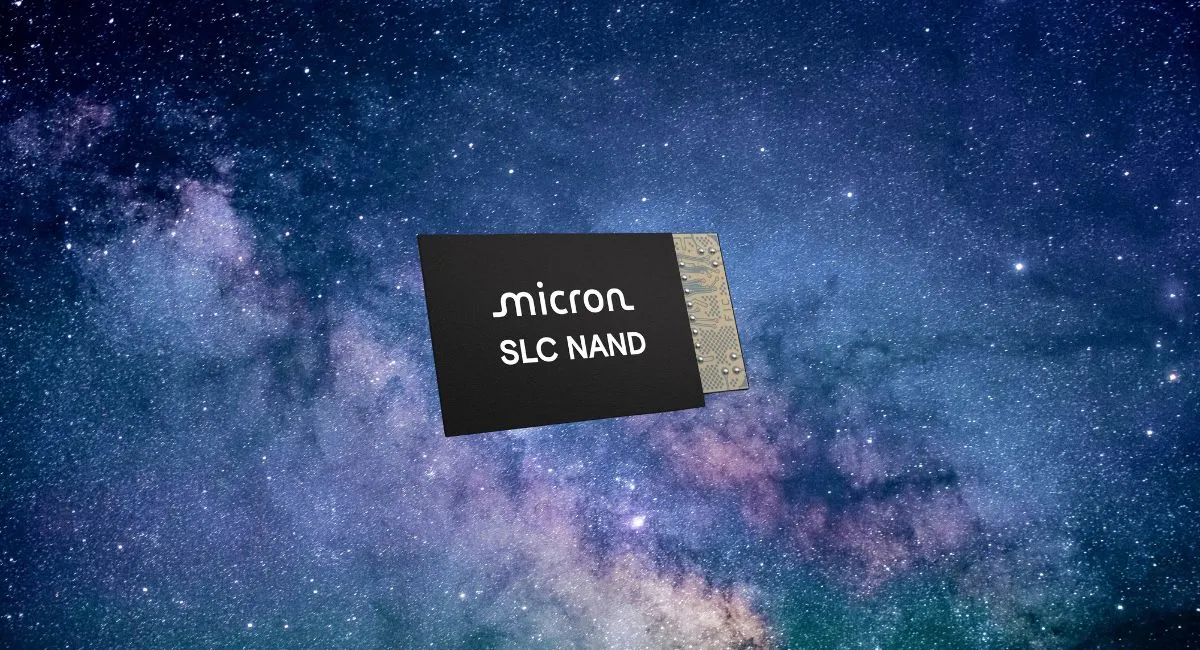
This new release marks the beginning of Micron’s broader aerospace portfolio, which will eventually include space-grade NAND, NOR, and DRAM products. With this launch, Micron becomes the first major memory vendor to offer this class of radiation-tolerant flash at 256Gb density.
Built for Orbit, Not the Lab
There’s no such thing as “good enough” in space. Every component must operate in a punishing environment where radiation, vacuum, shock, and extreme temperature cycling are routine. Micron’s SLC NAND is tested accordingly.
The device undergoes a year-long qualification flow, aligned with NASA’s PEM-INST-001 Level 2, including 590 hours of dynamic burn-in and temperature stress testing. On the radiation side, it’s been profiled for both Total Ionizing Dose (TID) and Single Event Effects (SEE), using standards like MIL-STD-883 and JESD57, to ensure functionality under prolonged exposure to cosmic rays and solar particles.
This kind of profiling is more than box-ticking; it allows system architects to model risk, plan mission lifetimes, and design redundancy into systems that may not see a servicing mission for decades, if ever.
Already Proven on the ISS
Although this is Micron’s first officially space-qualified NAND product, it’s far from untested. Through customers like Mercury Systems, Micron memory is already flying on missions. One standout example is NASA’s EMIT spectrometer, currently aboard the International Space Station, where Micron’s NAND is used in SSDRs that store complex spectral data.
EMIT captures over 100,000 spectra per second, feeding Earth science research that spans mineral dust mapping, water resource tracking, and even rare earth element detection.
According to Mercury Systems, Micron’s memory has proven stable and reliable across extended mission lifetimes, a critical benchmark for any aerospace-grade component.
Long-Term Commitment to Space
Micron isn’t treating this launch as a one-off. Backed by its position as the only U.S.-based memory manufacturer, the company is committing to end-to-end control of the aerospace supply chain, from wafer selection to traceability and lifecycle support.
Its recently announced investments in the Manassas, Virginia, facility will help scale production of NOR, SLC NAND, DDR3, and long-lifecycle DDR4/LPDDR4 options. Micron also plans to expand its support infrastructure, including regional aerospace labs and technical consulting teams tailored for high-reliability system development.
With next-gen missions pushing more compute and AI to the edge, demand for space-grade memory with real capacity is only growing. Micron’s latest offering puts them on the launchpad, and they’re clearly planning to stay there.
Learn more and read the original article on www.micron.com
Related Reading
Related news
More from Micron
Keep up with the components and technology shaping electronics.
Join the club for member features, engineering discussion and easier access to the latest Component Club content.