
Qorvo Advances Solid-State Power with Compact Wideband SSPAs
Qorvo’s new wideband Spatium SSPAs deliver TWTA-level performance with up to 50% smaller footprint and higher reliability for radar, SATCOM, and EW systems.
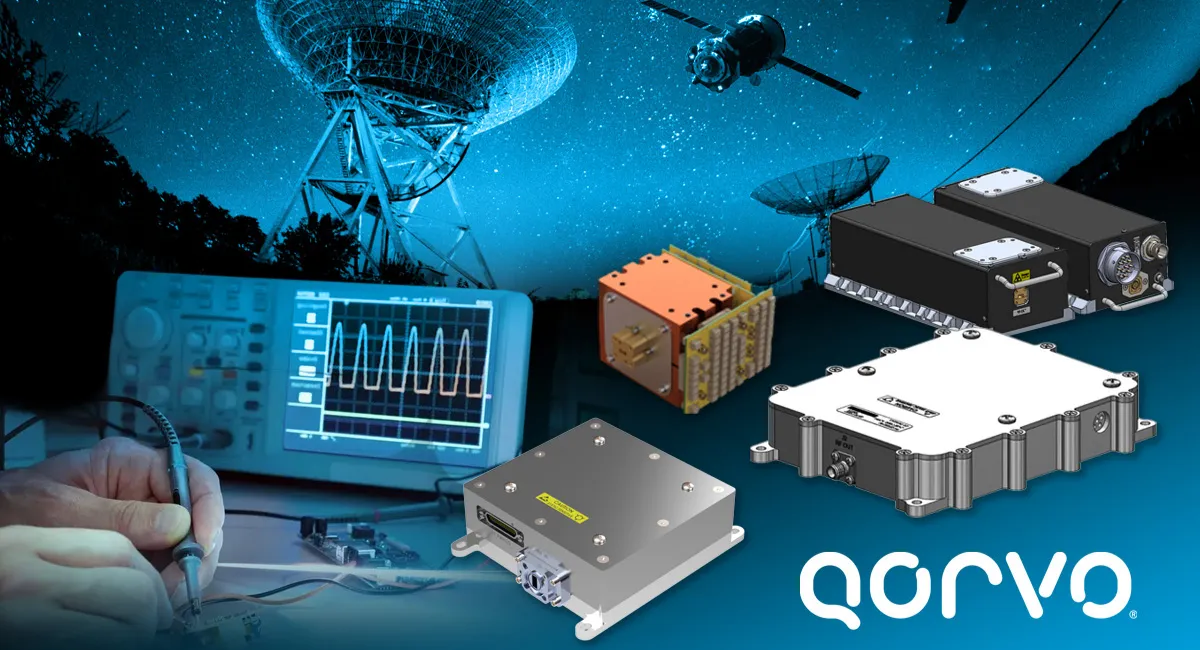
Shrinking Systems and Extending Lifetimes
The four new Spatium SSPAs deliver comparable output to legacy TWTAs while reducing overall system footprint by as much as 50 percent and cutting weight by roughly one-third. Each operates from standard 18–24-volt rails, removing the need for the bulky high-voltage supplies that have long defined tube-based designs.
By combining multiple GaN MMICs through Qorvo’s spatially combined architecture, these amplifiers maintain output even if one device fails. The result is graceful degradation rather than complete signal loss, a key requirement in radar, SATCOM, and electronic warfare equipment where continuous operation matters more than peak efficiency.
A Closer Look at the Lineup
The portfolio spans frequencies from 2 to 40 GHz, covering most wideband defense and test ranges. The QPR3238 and QPB1840N modules handle the upper-band applications, while the QPB3238J and QPB0618J address lower bands. Output powers range from roughly 15 to over 100 watts, all in connectorized modules that integrate driver and bias circuitry for straightforward system design.
Reliability Over the Long Term
Beyond size and weight reductions, these amplifiers address a growing challenge in the defense electronics industry: the shrinking supply of traveling wave tubes. With solid-state power, engineers gain predictable availability, simpler logistics, and operating lifetimes measured in tens of thousands of hours. For airborne and mobile platforms, that means fewer maintenance intervals and lower total cost of ownership without compromising RF performance.
Qorvo’s Spatium technology shows how modern wideband solid-state designs can meet or exceed TWTA benchmarks while delivering the reliability and scalability demanded by next-generation systems.
Learn more and read the original announcement at www.qorvo.com
Related news
More from Qorvo
Keep up with the components and technology shaping electronics.
Join the club for member features, engineering discussion and easier access to the latest Component Club content.