
STMicroelectronics ST64UWB Extends UWB Range for Secure Access
STMicroelectronics introduces the ST64UWB family supporting IEEE 802.15.4z and upcoming 802.15.4ab ultra-wideband standards with multi-millisecond ranging, improved link budget using 18 nm FD-SOI, and radar sensing capabilities for automotive and smart device applications.
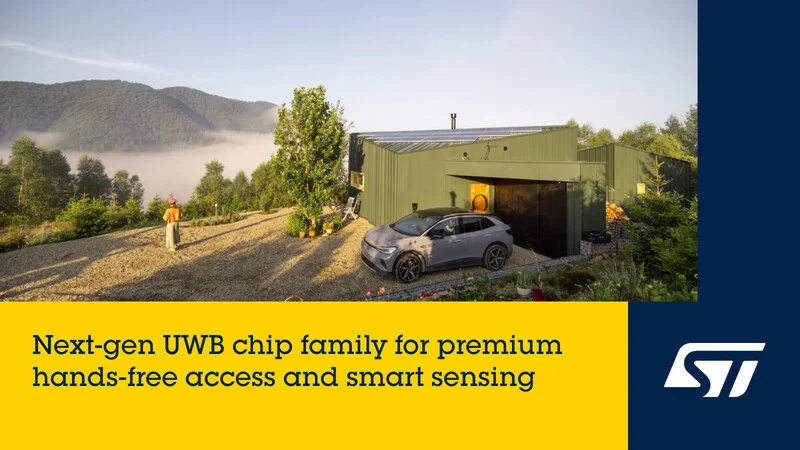
ST64UWB Architecture Introduces Multi-Millisecond Ranging
STMicroelectronics has developed the ST64UWB family around a newer interpretation of how UWB ranging should behave in real deployments. The devices support both the established IEEE 802.15.4z standard and the upcoming IEEE 802.15.4ab revision, which introduces a technique called multi-millisecond ranging. Instead of exchanging extremely short pulses over a narrow time window, the system stretches the ranging exchange across a longer interval. It sounds simple but it changes the physics slightly. Signals are allowed to travel farther before timing measurements close the loop, which makes longer-range positioning possible without sacrificing the time precision UWB depends on. When engineers begin experimenting with this behavior, the difference shows up quickly in environments where reflections and obstacles normally break the link.
Narrow-Band Assistance Quietly Changes Link Robustness
Another detail inside the architecture is the narrow-band assistance radio. UWB alone is excellent for timing precision, but maintaining a stable connection when the transmitter sits inside a bag or a coat pocket is less predictable. The additional radio channel gives the system another path to exchange synchronization information and maintain context between devices. It is not the headline feature, but in practice it can stabilize the link when the pure UWB path becomes unreliable. Engineers who have tested ranging systems in real spaces know how often those conditions appear.
FD-SOI RF Implementation Shapes The Link Budget
The ST64UWB devices are fabricated using STMicroelectronics’ 18 nm FD-SOI process technology. That choice shows up most clearly in the RF behavior. The link budget improves by roughly three decibels compared with typical bulk technologies, which effectively stretches the usable range further once the signal begins fighting through walls, vehicle panels, or clothing. The improvement is not dramatic in isolation, but link budgets rarely depend on a single parameter. Small gains accumulate. Engineers working on wireless systems learn that lesson quickly once a prototype leaves the lab.
Automotive And Consumer Systems Share The Same Silicon Base
Within the ST64UWB family the architectural core stays largely the same while the surrounding capabilities shift depending on the application. Automotive variants include an Arm Cortex-M85 processor and safety concepts aligned with ASIL requirements, supporting digital key systems and vehicle localization. A higher-end device adds digital signal processing and AI acceleration intended for radar-like sensing tasks. Child presence detection inside vehicles is one example. Gesture or kick sensing near the rear of a car is another. The same radio pulses used for ranging can be interpreted differently when reflections become the signal of interest. Consumer and building access systems use a related device that keeps the positioning capability but targets smart locks, presence detection, and hands-free entry systems. The interesting part is not the individual use cases. It is the slow shift in how UWB is being used. Originally it behaved like a precise measuring tape between two devices. Now it begins to look more like a sensing system that happens to communicate as well.
Learn more and read the original announcement at www.st.com
Image credit: STMicroelectronics
Related news
More from STMicroelectronics
Keep up with the components and technology shaping electronics.
Join the club for member features, engineering discussion and easier access to the latest Component Club content.