Diodes AP61204Q Buck Converter For Automotive Power Rails
Diodes has introduced the AP61204Q, a 2 A automotive-qualified buck converter with low IQ and compact SOT563 packaging for infotainment, telematics, and ADAS.
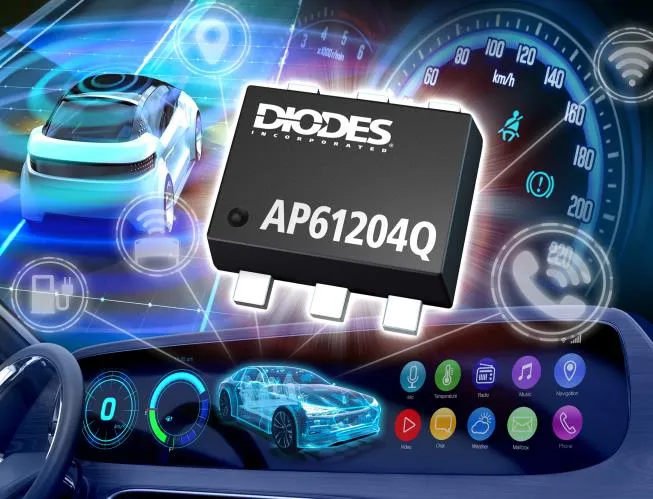
The device is a 2 A synchronous buck converter that runs from 2.4 V to 5.5 V, covering both 3.3 V and 5 V rails. It integrates 70 mΩ high-side and 50 mΩ low-side MOSFETs, helping it achieve efficient step-down conversion in a footprint no larger than a standard SOT563 package.
Features That Stand Out
What makes the AP61204Q interesting is the mix of automotive-grade reliability with a feature set that reduces external parts and keeps design simple:
- Constant on-time (COT) control for fast transient response and low ripple
- 19 µA quiescent current to boost light-load efficiency
- PWM/PFM mode select through an enable pin, giving engineers a choice between fixed frequency and higher efficiency at low loads
- Power-good (PG) output with ±5% accuracy, useful for sequencing and fault monitoring
- 2.4 MHz switching frequency that keeps inductors and capacitors small
- Soft output discharge to prevent residual charge on the rail
The part is also AEC-Q100 qualified and manufactured in IATF 16949-certified facilities, with PPAP support for automotive customers.
Where It Fits
Diodes is positioning the AP61204Q for point-of-load rails in infotainment, instrument clusters, telematics, and ADAS. By offering it in the same pin-compatible family as its 600 mA, 1 A, and 3 A devices, engineers can scale current capability without redesigning their board layout.
Final Thoughts
Step-down converters are everywhere in cars, but package size, efficiency, and qualification often make or break the choice. The AP61204Q brings a small package, low quiescent current, and proven automotive compliance, giving designers a part that is straightforward to integrate into space-constrained systems.
Learn more and read the original announcement here. Access the datasheet here.
Related news
More from Diodes Incorporated
Keep up with the components and technology shaping electronics.
Join the club for member features, engineering discussion and easier access to the latest Component Club content.