
Diodes Extends Automotive 48V Power Support with New Buck Converters
Diodes has released four automotive-grade buck converters rated up to 100V, delivering 3.5A with low EMI and robust protection for 48V rails.
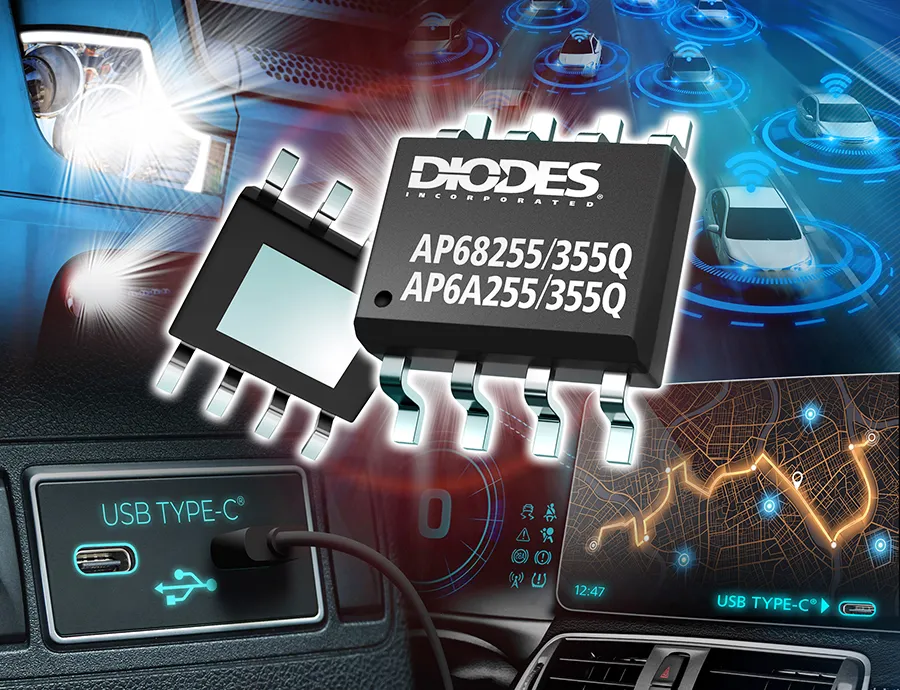
Covering the Full Automotive Voltage Range
The new devices AP68255Q, AP68355Q, AP6A255Q, and AP6A355Q, are rated at 80V and 100V, giving them headroom to survive the load-dump scenarios common in automotive systems. Each device integrates a 500mΩ MOSFET and can source up to 3.5A of continuous current, making them suitable for modules such as ADAS, infotainment, body electronics, instrument clusters, and lighting. With input coverage starting at 5.5V, they span the entire range of voltages an automotive engineer is likely to encounter.
Efficiency and Noise in Focus
Constant on-time control is used to maintain a steady switching frequency around 300kHz while responding quickly to changing conditions. The technique also reduces voltage ripple and cuts down the number of external components needed, a win for designers squeezed on board space.
Another subtle but important detail is the gate-driver design. Switching MOSFETs at high voltage is noisy, and EMI compliance is one of the more stubborn problems in vehicle electronics. Diodes has tuned the driver to suppress switch-node ringing without hurting performance, lowering radiated noise and simplifying the design-in process.
Protection Where It Counts
Reliability is always the final hurdle. Here, the converters add overcurrent protection with frequency foldback and thermal shutdown at 160°C, restarting automatically once temperatures fall back to 140°C. These guardrails help avoid failures in systems where ambient heat and sudden current spikes are unavoidable.
Packaging and Market Fit
The converters are housed in thermally enhanced SO-8EP packages and operate from –40°C to +125°C. Pricing starts at $0.80 in volume, with industrial-grade options available alongside the automotive-qualified parts.
As more car makers build 48V into their platforms, the need for compact, reliable, and noise-conscious power stages keeps growing. Diodes’ latest additions are a timely step into that space, offering engineers parts that balance efficiency, protection, and EMI performance in a package designed for the realities of automotive design.
Learn more and access the datasheets here.
Related news
More from Diodes Incorporated
Keep up with the components and technology shaping electronics.
Join the club for member features, engineering discussion and easier access to the latest Component Club content.