
Diodes Introduces Tiny eUSB2-to-USB 2.0 Repeaters for Compact Embedded Systems
Diodes Incorporated releases compact eUSB2-to-USB 2.0 repeaters for signal reliability in space-constrained embedded electronics and consumer devices.
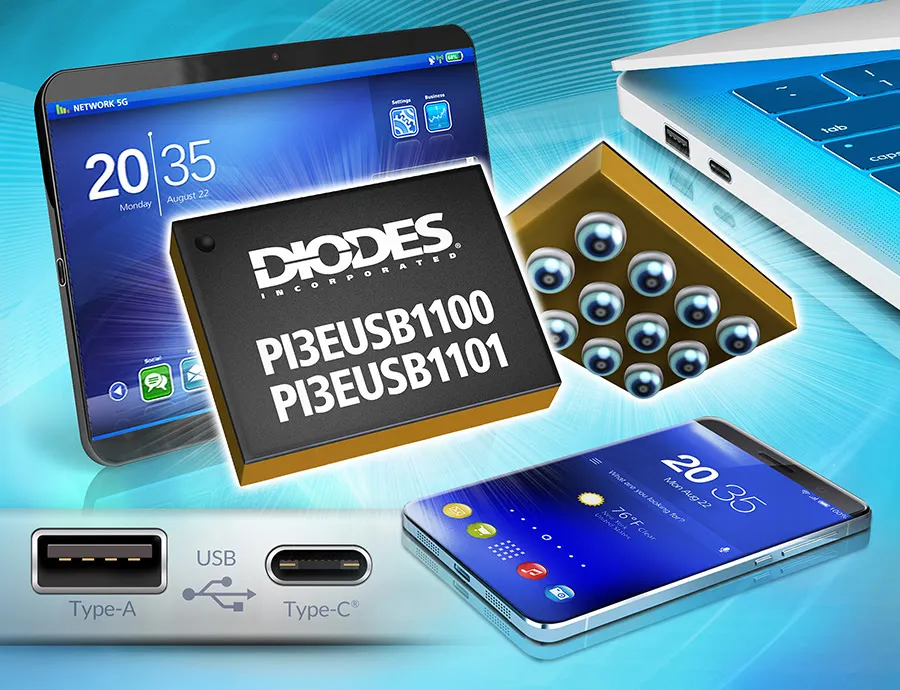
These devices are intended for designs where cameras, touch controllers or solid-state storage sit on eUSB2 internally, while a system still needs to present familiar USB Type-A or Type-C connections externally. The result is a cleaner board layout without sacrificing USB compatibility.
Maintaining Signal Integrity Across the Link
Both devices support low-speed, full-speed and high-speed USB 2.0 operation, ensuring broad compatibility with existing peripherals. Internal equalization adjusts to compensate for losses in longer trace paths or thin flex cables, and engineers can make further adjustments through an I²C interface.
This is particularly useful during compliance testing because transmit swing and de-emphasis can be tuned to match the characteristics of a given enclosure or connector. The devices also include adaptive power management that drops power consumption during standby or when a device is disconnected.
Designed for Modern Embedded Hardware
The repeaters operate from 1.8 and 3.3 volt rails and are qualified for the –40 to +85 °C industrial range, making them suitable for consumer electronics and compact IoT equipment. Both come in an extremely small 1.65 by 1.22 millimeter wafer-level CSP, a footprint that fits easily alongside image sensors and SoCs where every square millimeter counts.
The two variants differ only in the voltage used for the I²C interface. The PI3EUSB1100 communicates at 1.8 volts, while the PI3EUSB1101 supports 1.2 volt logic for newer low-power processors.
Why It Matters
eUSB2 is becoming more common inside compact electronics because it reduces routing complexity and board cost. These new repeaters provide an easy way to support traditional USB without redesigning the rest of the hardware. They give engineers flexibility during the transition while keeping external ports fully compatible with the wider USB ecosystem.
Pricing and Availability
Compare pricing and availability through our partner oemsecrets.com here: PI3EUSB1100 PI3EUSB1101
Learn more and read the original product announcement on www.diodes.com
Related news
More from Diodes Incorporated
Keep up with the components and technology shaping electronics.
Join the club for member features, engineering discussion and easier access to the latest Component Club content.