
Diodes MXQ Spread Spectrum Oscillators Reduce EMI In Automotive Clocking
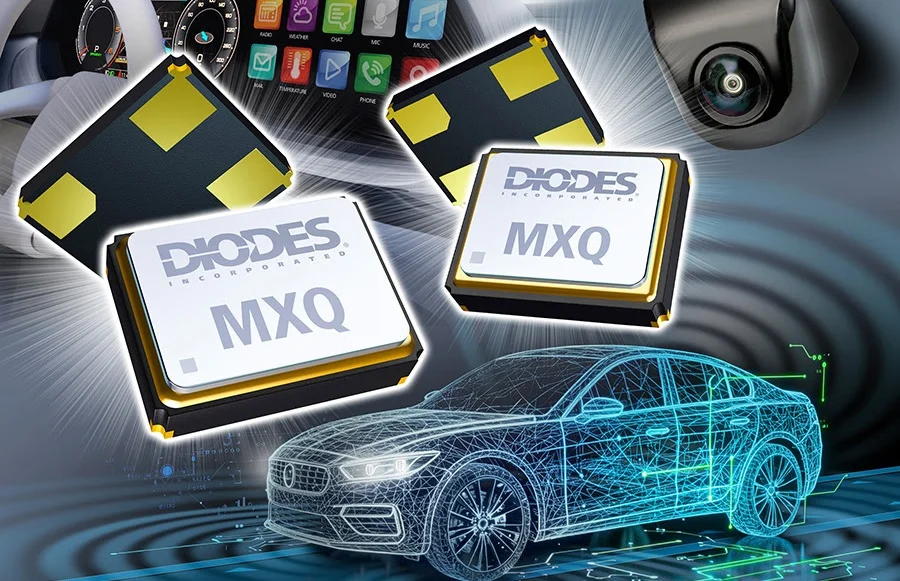
Diodes Incorporated’s MXQ spread spectrum oscillators reshape clock energy to reduce EMI in automotive and connected driving systems, offering multiple package sizes, programmable frequencies and stable jitter behavior for dense electronic designs.
Spread Spectrum Behavior That Helps Clocks Survive Automotive EMI Constraints
The MXQ family uses a phase locked loop combined with a spread spectrum generator to reshape the spectral footprint of the clock. Instead of concentrating energy at a single fundamental and its harmonics, the oscillator smears that energy slightly, reducing the amplitude of the peaks that normally complicate EMI compliance. This becomes particularly helpful in the connected driving space where multiple RF systems operate alongside high speed digital interfaces and power converters that switch aggressively. By synthesizing both the nominal frequency and the spread directly from the crystal, the device maintains stability while softening the EMI signature that tends to trigger redesigns late in the development cycle.
Package Options Sized For Distributed Clocking Architectures
The MX71Q, MX51Q, MX31Q, MX21Q and MX11Q options cover footprints from large to extremely compact, which helps designers place the oscillator close to the subsystem that needs it instead of routing a long clock trace through noisy areas. The smallest versions end up in places where board space is tight, such as in radar modules or compact telematics units where the clock sits close to sensitive analog or RF paths. Larger packages suit areas where mechanical robustness and accessibility matter more than footprint. Across all sizes, the oscillator keeps jitter and spread behavior consistent enough that the downstream systems do not need custom filtering or equalization to tolerate the spectral shifts.
Flexibility That Adapts To Mixed Automotive And Industrial Designs
Automotive systems often need clock frequencies that vary across modules, and the MXQ devices are factory programmed so designers can match the output to the subsystem without complicating the bill of materials. Jitter and spread ratio selections give enough room to adjust the oscillator to the needs of different digital interfaces or sensing modules. For industrial or commercial systems that do not require automotive compliance, the related MX series mirrors the core behavior without the qualification overhead. This helps designers maintain similar spectral characteristics across product lines even when the reliability or regulatory demands differ.
A Clock Source Built For Modern Distributed Systems
Connected driving architectures rely on synchronized data movement between many processing elements, and the clock becomes the quiet but essential component connecting them. Spread spectrum oscillators are increasingly used to keep the electromagnetic environment stable enough that radios, sensors and digital interfaces can coexist without taking turns fighting each other. The MXQ family supports that shift by giving engineers a clock that fits into small enclosures, holds its spectrum under control and adapts to the constraints that appear when digital and RF domains share the same vehicle. It provides a cleaner starting point before the rest of the system begins adding its own noise.
Learn more and read the original announcement at www.diodes.com
Related news
More from Diodes Incorporated
Keep up with the components and technology shaping electronics.
Join the club for member features, engineering discussion and easier access to the latest Component Club content.