Diodes Tightens SR Control on the LLC Secondary Side
Diodes’ APR3492 is a dual-channel synchronous rectification controller for LLC converters, built to improve turn-off timing, light-load behavior, and secondary-side control across changing operating modes.
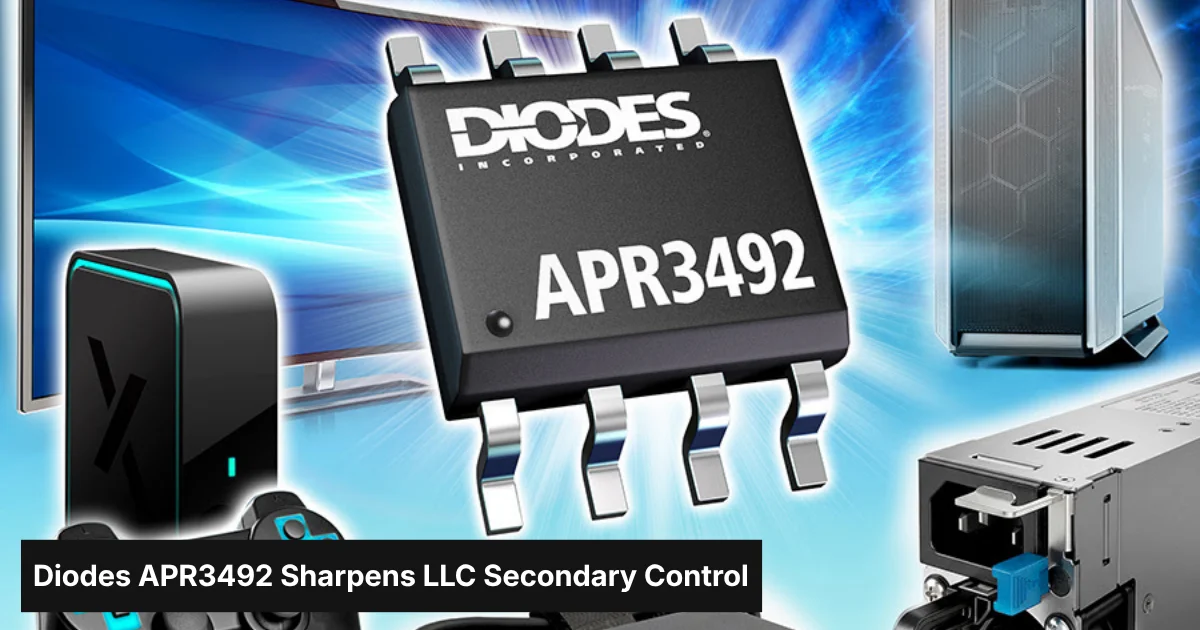
In a typical adapter or TV power stage, the synchronous rectifier is supposed to clean up conduction losses without turning into the awkward part of the converter. That gets harder once the LLC stage moves between CCM, CrCM, and DCM, because the secondary no longer behaves as neatly as the topology diagram suggests. Diodes says the APR3492 is built to handle all three modes, which is exactly where a part like this needs to prove itself.
Turn-Off Speed Is The Real Story Here
The obvious headline would be dual outputs, but that's not really the point. The more useful detail is the way APR3492 is set up to get out of conduction quickly and predictably. Diodes gives a typical 70 ns turn-off propagation delay, a 100 ns turn-on delay, and a typical 30 mV turn-off threshold. Those numbers aren't interesting because they look tidy in a table. They're interesting because the secondary side of an LLC stage gets expensive very quickly when the SR MOSFET stays on longer than it should.
The part also uses forward-voltage regulation during on-time to accelerate turn-off. That's the sort of detail that says more about the device than the dual-channel label does. Once current starts falling and the rectifier is getting close to the edge of where it should stop conducting, the controller is already trying to push the gate drive in the right direction. That's a much better answer than simply hoping the transition stays clean under changing load conditions.
Light Load Is Usually Where The Secondary Gets Messy
The APR3492 also includes a dedicated light-load mode, and that is probably one of the more useful parts of the release. In light-load operation, it latches off the drive signals and drops the current draw, with the entry threshold set by an external resistor on the LL pin. That is a practical choice because the secondary side does not need to keep behaving like it is chasing peak efficiency once the supply has already backed away from heavy load.
However, light-load behavior is rarely the only problem. Once burst mode or skip behavior shows up elsewhere in the converter, the secondary can start seeing LC oscillation periods that make false turn-on much easier. Diodes has built in turn-off blanking logic to prevent cross-conduction between the two channels, and the datasheet is quite clear that this sits alongside an intelligent control scheme intended to minimize turn-on and turn-off delay. That is a more believable engineering story than a generic efficiency claim.
Dual Outputs Help, But Cleaner Control Helps More
The APR3492 does simplify the hardware. One device handles both channels, supports high-side and low-side SR arrangements, and keeps the external component count down. That is useful. But the stronger case for the part is still about control behavior. If the controller can keep the secondary-side MOSFETs from overlapping, shut them off quickly, and stay stable across CCM, CrCM, and DCM, then it is solving the part of LLC synchronous rectification that usually becomes annoying first.
The absolute maximum drain rating is 200 V, recommended VCC runs from 4.2 V to 51 V, and the typical operating current is 16 mA. Those figures are solid enough, but they're not the reason to pay attention. The better reason is that LLC secondary control is still one of those areas where small timing decisions shape whether the converter feels sorted or not. APR3492 is very obviously aimed at that pressure.
Learn more and read the original announcement at www.diodes.com
Technology Overview
The APR3492 is a dual-channel secondary-side synchronous rectification controller and MOSFET driver for LLC resonant converters. It supports CCM, CrCM, and DCM operation, drives both high-side and low-side N-channel MOSFETs, and includes light-load mode, turn-off blanking, and anti-cross-conduction control. The device is available in an SO-8 package and supports drain voltages up to 200 V.
Frequently Asked Questions
What is the APR3492 used for?
The APR3492 is used for secondary-side synchronous rectification in LLC resonant converters such as AC/DC adapters, LCD and LED TVs, and other high-efficiency SMPS designs.
Does the APR3492 support CCM, CrCM, and DCM?
Yes. Diodes states that the APR3492 supports continuous conduction mode, critical conduction mode, and discontinuous conduction mode.
What package is the APR3492 available in?
The APR3492 is available in the standard SO-8 package.
Related news
More from Diodes Incorporated
Keep up with the components and technology shaping electronics.
Join the club for member features, engineering discussion and easier access to the latest Component Club content.