
Infineon Launches Self-Calibrating Hall Angle Sensors for Motor Control
Infineon launches XENSIV TLx49012 digital Hall angle sensors with automatic self-calibration, less than 0.1° accuracy and 1.5 µs latency for automotive and industrial motor control.
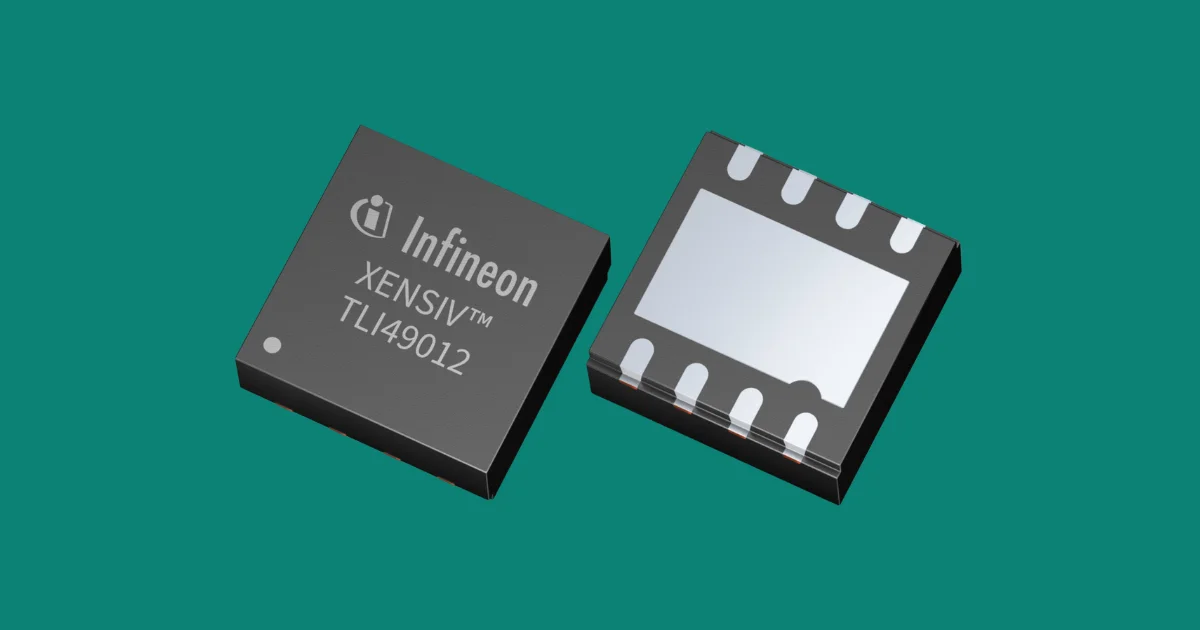
The four-sensor family adds system self-calibration, removing the need for customer-developed calibration routines and external reference encoders. Automatic initial calibration and continuous on-chip compensation support both on-axis and off-axis mounting configurations.
Alongside the calibration function, the TLx49012 sensors provide angle accuracy of less than 0.1° and latency of 1.5 µs for rotor-position feedback in high-speed and dynamic motor systems.
Calibration Handled Inside the Sensor
The self-calibration function is the main addition in the TLx49012 family. Rather than requiring calibration to be developed elsewhere in the system, the process is handled automatically by the sensor.
Initial calibration establishes the sensor configuration, followed by continuous on-chip compensation during operation. Infineon says this removes the need for an external reference encoder during calibration and reduces the work needed to integrate the sensor into a motor system.
Support for on-axis and off-axis mounting also gives designers more choice over sensor placement where mechanical layout restricts the position of the sensor relative to the magnet.
The supported magnetic field range extends from 20 mT to 120 mT, covering standard magnet configurations used across automotive and industrial motor platforms.
Fast Rotor-Position Feedback
The TLx49012 family combines its self-calibration capability with angle accuracy below 0.1° and 1.5 µs latency. Infineon is targeting motor-control applications where accurate, low-latency rotor-position feedback is required, including brushless DC motors.
Several interface options are available, including SPI, ABZ, UVW and PWM, allowing the sensors to work with different motor-controller architectures.
The family includes TLE49012 variants for automotive applications and TLI49012 variants for industrial systems. Automotive-qualified TLE49012 devices are ISO 26262 compliant and achieve ASIL B.
Both the XENSIV TLE49012 automotive variants and TLI49012 industrial variants are available now.
Learn more and read the original announcement at infineon.com.
Technology Overview
The Infineon XENSIV TLx49012 family consists of digital Hall angle sensors for automotive and industrial motor control. The sensors provide angle accuracy of less than 0.1°, 1.5 µs latency and support magnetic fields from 20 mT to 120 mT. Automatic initial calibration and continuous on-chip compensation support both on-axis and off-axis mounting without requiring customer-developed calibration routines or external reference encoders.
FAQs
What is the self-calibration function in the TLx49012?
The TLx49012 handles initial calibration automatically and provides continuous on-chip compensation during operation. Infineon says this removes the need for customer-developed calibration routines and external reference encoders.
Can the TLx49012 sensors be used in off-axis configurations?
Yes. The TLx49012 family supports both on-axis and off-axis mounting, giving designers more flexibility when positioning the sensor within a motor system.
What is the difference between the TLE49012 and TLI49012?
The TLE49012 variants are designed for automotive applications, while the TLI49012 variants target industrial systems. The automotive-qualified TLE49012 devices are ISO 26262 compliant and achieve ASIL B.
Related news
More from Infineon
Keep up with the components and technology shaping electronics.
Join the club for member features, engineering discussion and easier access to the latest Component Club content.