
Renesas R-Car X5H Targets Multi-Domain SDV Compute at 3nm
Renesas R-Car X5H brings 3 nm multi-domain compute, AI acceleration and SDV-ready software support for next-generation vehicles.
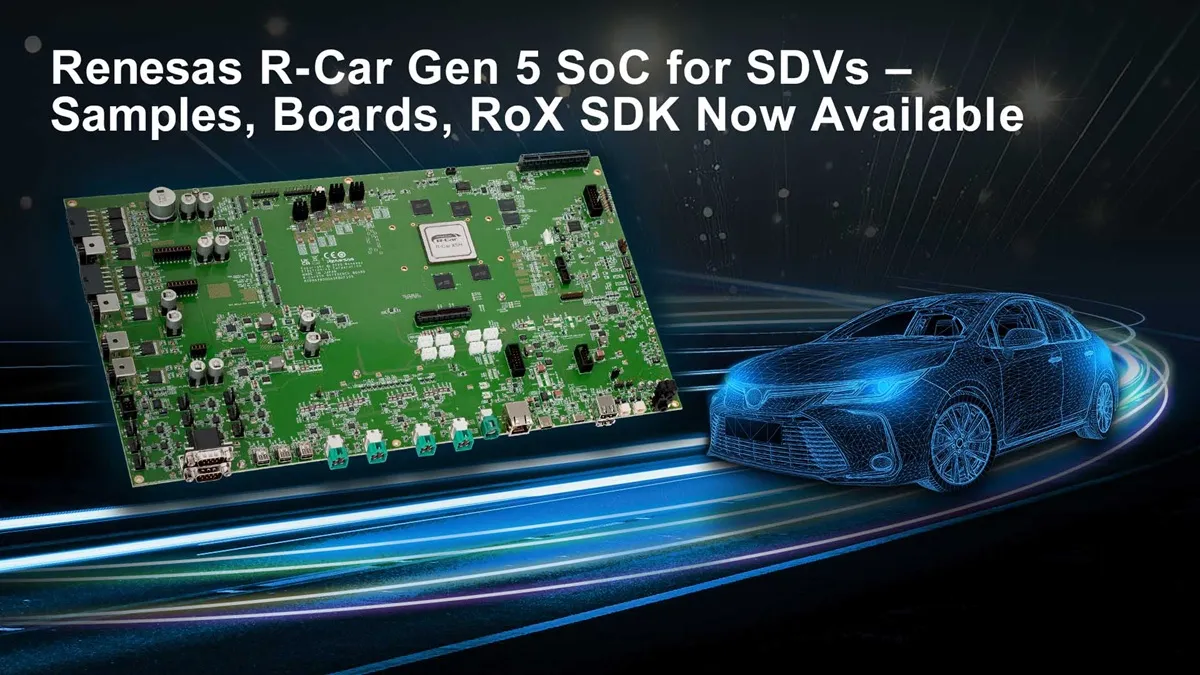
Consolidating Vehicle Domains on a Single SoC
The core engineering challenge behind software-defined vehicles is not raw compute alone, but safe consolidation. ADAS workloads, cockpit graphics and vehicle networking have very different latency, safety and determinism requirements. The R-Car X5H is built to handle this mixed criticality problem directly, allowing engineers to deploy multiple domains without resorting to physically separate processors. In practice, this reduces board complexity, shortens signal paths and simplifies power distribution, while also lowering overall system power and cost.
Compute, AI and Graphics Headroom for SDV Architectures
Fabricated on a 3 nm process, the R-Car X5H brings a notable jump in performance density. Renesas is quoting up to 35 percent lower power consumption compared with previous 5 nm designs, which matters as centralized compute platforms begin to replace dozens of distributed ECUs. The device combines 32 Arm Cortex-A720AE application cores with six Cortex-R52 lockstep cores to support ASIL D safety requirements. On the acceleration side, up to 400 TOPS of AI performance is available, with the option to scale further using chiplet-based extensions. Graphics capability reaches the equivalent of 4 TFLOPS, enabling high-end instrument clusters and multi-display infotainment systems without offloading rendering elsewhere.
Mixed-Criticality Execution and System Integration
Running safety-critical and non-critical software on the same SoC only works if isolation is robust. The X5H supports mixed-criticality execution across domains, allowing real-time control tasks and AI-driven perception workloads to operate concurrently without interference. For engineers, this simplifies E/E architectures and reduces the need for complex inter-processor communication schemes. Support for large camera and display configurations, including up to eight high-resolution camera inputs and multiple 8K2K displays, positions the platform for sensor-rich ADAS and immersive cockpit designs.
RoX Whitebox SDK and Practical Development Flow
Hardware capability alone is not enough to shorten vehicle development cycles. Renesas is pairing the X5H with its RoX Whitebox SDK, an open development environment built around Linux, Android and the XEN hypervisor, with optional support for AUTOSAR, QNX, SafeRTOS and other automotive operating systems. The goal is to let teams start software integration early, long before final hardware is locked down. Pre-integrated AI, ADAS and perception stacks, along with partner software for HMI, audio and vision processing, reduce the upfront integration burden that typically slows SDV programs.
What This Signals for Future Vehicle Platforms
Centralized compute and software-defined architectures are becoming the default direction for new vehicle platforms. Devices like the R-Car X5H highlight how advanced process nodes, scalable AI acceleration and open software ecosystems are converging to make that shift practical. For engineers, the takeaway is clear. Future vehicle designs will increasingly depend on flexible, multi-domain SoCs that can evolve through software updates rather than hardware redesigns. Platforms that support early development, safe consolidation and long-term scalability will shape how quickly OEMs can bring new vehicle capabilities to market.
Learn more and read the original announcement at www.renesas.com
Related news
More from Renesas
Keep up with the components and technology shaping electronics.
Join the club for member features, engineering discussion and easier access to the latest Component Club content.