
Infineon MOTIX SiP Shrinks Automotive Motor Control Boards
The Infineon MOTIX TLE9954QSW40-33 integrates MCU, power stage and motor driver functions in a compact SiP, reducing board size and improving thermal and EMC behavior for automotive pumps, fans and actuators.
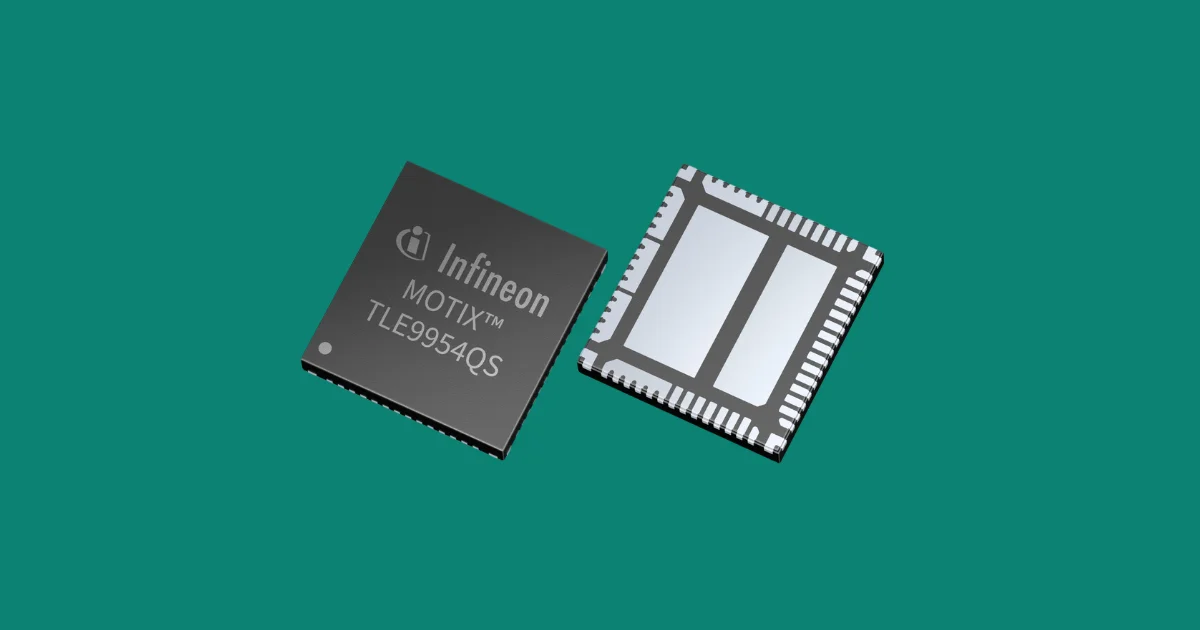
Integrated Architecture Built Around Thermal And Parasitic Constraints
The device merges a microcontroller, a three phase bridge driver, the OptiMOS 7 power stage, the power supply and the communication interface into a single LIQFN package. This is not just about part count reduction. When the MOSFETs and the controller live on the same substrate, the parasitic inductance that usually shows up around fast commutation events becomes far less intrusive. You notice it when the gate drive no longer needs the extra tuning that discrete layouts force in small fans or coolant pumps. The package spreads heat into the PCB more effectively than a traditional multi device arrangement, which matters in EV thermal systems where the ambient can drift upward for long periods.
Control Resources Designed For Small, Repetitive Motion Profiles
Inside the SiP sits an Arm Cortex M23 core running near 40 MHz with on board flash and RAM sized for compact motion routines. Field oriented control runs efficiently enough that the microcontroller does not feel overloaded when the LIN messages stack up or when the PWM update rate climbs during transitions. The CCU7 timer block removes some of the housekeeping that would normally sit in firmware, and automatic LIN message handling keeps the processor from spending cycles on communication maintenance. These small shifts in behaviour become visible when you look at current ripple or timing jitter under load.
Package Behavior Tuned For Space Constrained Automotive Boards
The LIQFN 58 package is shaped to move heat through its footprint in a way that helps keep the MOSFET junctions predictable. In practice this lets a pump controller shrink to a size smaller than a postage stamp without the usual concern of corner heating or uneven spreading. Engineers working on seat motion or valve actuation will recognise the benefit immediately. The parasitic reduction also helps EMC behaviour at higher switching speeds, which becomes important when long harnesses act as antennas inside the vehicle. Layouts that were previously uncomfortable at elevated frequencies gain some breathing room.
Safety Integration For Mixed Load Automotive Environments
The SiP supports hardware isolation for security and safety critical zones through Arm TrustZone, giving designers a way to partition logic that interacts with battery systems or thermal modules. AEC Q100 Grade 0 qualification places it in environments where temperature swings are significant, and ASIL B capability aligns with the functional safety requirements of modern comfort and thermal systems. This level of integration shortens the time it takes to build a robust motion subsystem, especially when paired with reference designs like the 150 W water pump platform that Infineon offers. You can see how this shifts the architecture of small automotive actuators, moving them toward compact control blocks rather than distributed discretes.
Learn more and read the original announcement at www.infineon.com
Related news
More from Infineon
Keep up with the components and technology shaping electronics.
Join the club for member features, engineering discussion and easier access to the latest Component Club content.